All posts by William S Grant

William Grant is a consultant for one of the Big Four consulting firms in London and regular contributor to Novel Stance.

UK General Election: The Battle Against Proportional Renunciation

It’s a strange time we live in: the General Election to determine the direction of the United Kingdom’s fortunes will take over the next 5 years gets arguably less hype than a boxing match on the other side of the Atlantic between two half-pint heavyweights—although perhaps, in the case of the boxing, it’s much easier to pick your favourite.

The way I interpret my generation—the Gen Y, the Millennials—is that they seem so turned off from politics that the concept of travelling to a polling station and ticking a box is viewed as a considerable inconvenience. It’s difficult to find anyone in the same age bracket who is truly politically aware, and not just spouting media platitudes and ignorance. But who can blame us? Over the last 6 months especially, we have become incredibly frustrated watching the endless stream of spin, counter-spin, petty, “he-said-she-said” political one-upmanship in full force. Whether you were for or against, the Scottish Independence debate was undoubtably a powerful demonstration of democracy. It supercharged a nation into discussion, but the UK has gone backwards with Westminster relegating the real point of politics to the second tier of issues.

This has to be addressed, urgently. Whilst the next leaders will be decided by the system of first-past-the-post, we are in danger of undermining the very fabric of the UK with a system of proportional renunciation, where people choose to throw away one of the most important democratic rights given to a citizen. To tackle this we look at the first logical question: why could you possibly choose not to vote come the 7th of May?

Vote Veto

“Politics” is derived from the Greek “of, for, or relating to the polis” (where “polis” refers to “city,” i.e. the collective will of inhabitants). You would think, then, that focus would be given to issues that affect the everyday man and woman. If this UK election campaign is anything to go by, you’d be wrong.

The UK airs Leaders’ Debates, Leaders Interviews, “An Audience with [insert leader here],” photo opportunities and personal attacks. I tune into these intently (even if just to fulfil my masochistic tendencies) and have an interesting reflection on the content: someone can absorb all that is said, turn their television off and feel more confused than before they started.

Politicians are a funny species: at once trying to sound not-too-intellectual to appeal to the working class, whilst also trying to sound semi-intellectual to appeal to the upper class. What therefore manifests itself is a strange combination of talking entirely in circles, clichés, and rehearsed sound bites, coming across as out-of-touch at best (and creepy at worst).

British politics has become heavily Americanised, with great focus being placed on the personal merits of the figureheads of the political parties. The great electoral “spin” machine is therefore in full flow, with every gaffe and mistake magnified to epic proportions. I am a fan of the genius of Armando Iannucci, but his show “The Thick of It,” following a group of hapless MPs and their struggles with “spin,” is probably (and worryingly) spot on. The pressure on these leaders is intense, and the nature of disagreements between them often highly personal. Whilst a strong leader can be important, surely we must focus more on promises and pledges? That being said, this bunch of leaders is one special group.

The Candidates
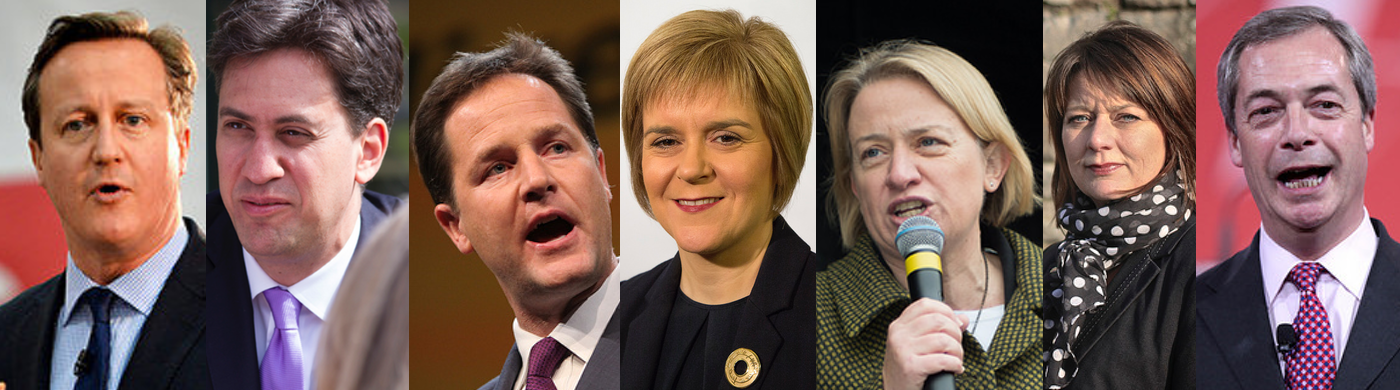
 

General Election Candidates

Cameron
Conservative

Current Prime Minister of the UK, friend of bankers, and bread-maker. He is staunchly defending his record as PM, some would say in a whirlwind of arrogance.

Miliband
Labour

The great pretender, beacon for the working classes. He uses an Oxford education and a nice-guy nature to try and convince everyone he’s hard enough whilst seemingly being incapable of talking without pinching mid-air.

Clegg
Lib Dem

Former golden boy, now gallantly trying to regain all credibility lost over the course of an abusive marriage with the Tories.

Sturgeon
SNP

The Glesga Bauchle, holding her own with the support of an entire country, but with the ominous double-edge of wanting to tear down the institution for which she is campaigning.

Bennett
Green

The alternative-alternative choice, fighting against the big parties’ oppression.

Wood
Plaid Cymru

Standing her ground for The Valleys, but with less muscle than the other nationalists.

(And then, of course, the Pantomime Villain)

Farage
UKIP

Polariser of opinions, pint-on-head-man-at-pub layman, frantically trying to politicise prejudice.

It’s no surprise that some of the electorate, myself included, struggle to relate to any of the above. Listening to them one-up each other through debates sees real issues being side tracked (hence the state of confusion and irritation after viewing). That the election has become all about personality is a poor reflection on the intelligence of the British people, but it seems to be the outcome  the media has wanted all along.

Glancing over the ability to relate to the figureheads on a personal level, some of us struggle to identify with the values of any party anymore. Labour was established as the party of the working man, but was since managed to blur the line between themselves and the traditionalist Tories. The Tories—big on business, banking, and the bourgeois—have little to link them to working class families or students. The nationalists benefit from fervent passion from their own countries but, by definition, should not succeed at a UK level. The Lib Dems, previously a genuine alternative to the Big Two—especially for students—have done exactly what was expected and traded principles for power, losing the trust of the majority of their support. UKIP, often misrepresented by the media, still harbour a dangerous right-wing angle and threaten to cut us off into splendid isolation once more. The Greens promise the world in their manifesto, safe in the knowledge they are unlikely to have to deliver on any of it. It’s safe to say that the ‘undecideds’ have a hard choice, with a veto vote looking ever more appealing.

Our political system is still  (somewhat controversially) first-past-the-post (FPTP). To break the traditional duopoly of the Big Two—Labour and Conservative—some call for proportional representation (PR). The PR system is far more egalitarian, especially in our current system where more than two parties will have an influence. At the moment, the FPTP system has precipitated a Games Of Thrones-esque jostling for position amongst all political parties, with deals being offered, denied, and countered before the election has even begun, with the SNP even offering to prop up a minority government. A commonly held view of FPTP is that your vote does not matter if your candidate does not win your local ‘seat.’ Therefore, for example, the majority of young, liberal left wing constituents in Tory-Heartland areas in the South could be likely to spend election day somewhere else than in a polling station.

This snapshot could be a reason why a large majority of the population does not vote. Disengaging leaders, ambiguity in values and an unfit-for-purpose political system has lead to increasing levels of voluntary disenfranchisement in each election since 1945 (we have, at least, seen an increased number in the last two elections). Given the history of the Lib Dems in particular, if our chosen party does win some influence, there is no guarantee that they will be able, or willing, to keep their promises. If we feel it won’t make a difference, why bother?

Brand new world, why should we vote?
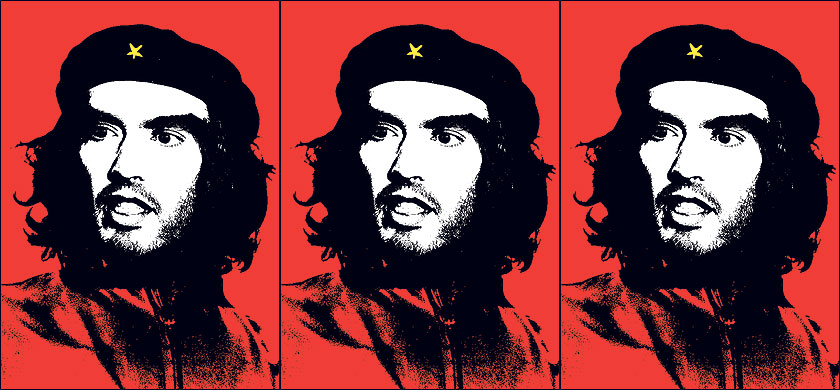
 

brand-che

Russell Brand has morphed himself from abstract comedian to a modern day political Che Guevara, the prominent voice encouraging society to turn their backs on the democratic system pandering to the “lies, treachery and deceit of the political class” and forego their right to a vote. Although an admirer of Brand’s easily-placed wit, lexicon and passion for his cause, this author believes we must not be convinced that this is the way to go.

To forego one’s right to vote is a complete insult to the history of enfranchisement. It is an insult to the countless working people who presented Parliament with petitions to tackle the voting monopoly of the landowners; to the African-American Civil Rights campaigners in the 19th and 20th centuries; to Emily Wilding Davison who gave her life in the cause of Women’s Suffrage alongside the Suffragettes; to the victims of World Wars who contributed to freedom from Fascism, and countless more. Whilst we take our votes for granted and often see the whole election coverage as an annoyance, we forget the plight which our ancestors have gone through to get us here. We forget that there are countries in the world today where the citizens are crying out for the same freedoms: Saudi Arabia, Central African Republic and North Korea to name but a few. Yes, it is ironically also our democratic right not to use our vote, but it seems such an inconsiderate waste given all the sacrifices that have gone before.

The decreasing feeling of community in Britain today could be another reason for a low turnout. Culturally, we see ourselves far more disconnected from our neighbours and countrymen than ever before, whether due to technology, immigration, fear, or other. With individualistic outlook comes a lack of perspective as part of a collective, leading to the view “well, my one little vote won’t matter.” What if thought that? Democracy would collapse. Imagine the opposite: everyone in the country turns up to vote. Every vote is a demonstration of opinion and when banded together, political movements take shape. The Scottish referendum debate broke records for turnout, with nearly 85% of eligible people casting their votes, which was precipitated by the flagrant support for the SNP at the polls, confirming their mandate for Independence. The result was therefore highly credible. Whatever you think about the political system and political parties, the only way to change it is to use your vote for the group who will represent your opinions and values on your behalf.

Go out and vote

Getting yourself to the polling station is only half the battle. It’s sometimes even literally a battle, with desperate campaigners at the gates forming a human barricade of leaflets and flags. Is anyone actually so impressionable to actually have their minds changed at the door to the ballot box?

The term “protest vote” is banded about almost daily these days. The alternative parties have gathered support, with a lack of belief in the Conservative-Labour dynasties, but a commonly held view is that a vote for any of these is simply a wasted vote in terms of keeping the lesser of two evils out of Downing Street. How can it be that votes are cast pessimistically as this? “I’ll vote against what I don’t want, rather than what I do;” the concept of the “protest vote” needs to be removed. Having been given the freedom to elect, we now have the responsibility to research as much relevant information as possible, consider what meets our values, and vote accordingly, both at a local and national level. Even comedian Al Murray is running with his FUKP party, although some of his “policies” are rather suspicious—but hey, whatever floats your political boat.

Some commentators have even argued for “none of the above” to be included in the ballot box, an interesting option given the reservations I have previously laid out over the current choices. The reason for this is highlighted strongly in our current election campaign, with antipathy for the Big Two meeting lack of genuine alternatives for a large proportion of the electorate. Whilst some would say that picking this option is a wasted vote, if millions of people around the country did the same, this could not be ignored by the ruling parties. The ignominy of an MP trudging to Parliament as second-placed in his constituency to a “none of the above” winner could also inspire powerful action on that representative’s part to justify their position ahead of the next election.

In general, the mindset for the average voter is interesting. We have to, at once, consider ourselves independent individuals casting a vote for who we want to see, but also know that we are part of a collective and our vote only really counts when banded with the others across the country. I’m sure a psychologist would have a field day with that one. The crucial principle is that, for whatever reason, we do actually go out and cast our vote, even if it’s just to get out of the house at midday on a Thursday.

Golden Engagement

Although I have discussed the limitations of TV debates, where arguments are lost amongst back talking and guffawing, it is at least an attempt to bring politics back to the masses. They’ve even started using social media, with each main party having their own Twitter account, probably contributing to the increase in turnout over the previous two elections. Politics is still often seen as a boring topic, rivalling “oh, this is my axe-wielding hand” and “I’m an accountant” for conversation stoppers at a social gathering. One of the greatest aspects of politics is that people can have such differing opinions on the same issues. Luckily, discussion amongst ourselves is one of the best way to become informed and clear in your own views. Whether the discussion takes place on social media, in the pub, or on a bus with a stranger, it has the potential to broaden our understanding of society and each other. After all, Brits love to complain, there is nothing worse than complaining about “the state this country is in” when you have not even taken your chance, every 4–5 years, to tell the government exactly what you think.

If all else fails, I say we just take a leaf out of the Mayweather-Pacquiao guidebook and put all the leaders in a ring with a set of boxing gloves each. Apparently, we’d never have to worry about hyping up the election then. In the fight against the widespread renunciation of the voting right, one must turn the tide for the sake of ourselves and our children. The next generation may even take a different form of political system or democracy to dissuade feelings of apathy and indifference. Regardless of the result, you will have exercised a freedom that forms the foundation of the civilised world; you will have made your contribution to the future of your country.

As for who to vote for, I’ll let you decide.
Religion: The Beautiful Game?

In the beginning, Something created Everything—the rest is just speculation…

It was late, dark, and bitterly cold. Walking home, making the usual right-turn into my own street, half conscious after another tough day at the office, I spotted two shadowy figures approaching on the pavement ahead. As I crossed the road towards my house, strangely, the silhouettes mirrored my movements. Suspicious of the coincidence of the currently anonymous figures, I carried on, gaze fixed firmly on the ground as we got closer. Within a few feet, I heard a “hey!” The thoughts that go through a tired mind in that situation are many and varied: Who is this? Why are they talking to me in the street? Do I know these people? I am about to be attacked, yards from my own door? Fight-or-flight engaged, I looked up to confront my accosters…

The first thing I spotted was the goofy smiling faces, instantly lessening any sense of danger. Then, looking down at impeccable blazers wrapped around winter coats, the badges and motif: The Jesus Christ Church of Latter Day Saints. The universal sign that suggests, “you are not about to be mugged… but a mugging might be more enjoyable.”

Like many an atheist, the dismissive attitude towards any kind of potential religious or spiritual engagement is something I have previously relaxed into in every similar situation my whole life. Whether through a lack of connection to the subject matter, a general suspicion, or a staunch (nay militant) anti-theist stance, we non-believers tend to react negatively to any attempt made by those of faith to engage us in the Divine. Recently, after some eye-opening experiences, I have begun a process of mellowing somewhat. After all, within the UK, 75% of people identify with a religion. They can’t all be wrong…right?

And this is the purpose of this piece: to challenge the attitude of atheists towards believers.

A secular metaphor

A wise friend once used a metaphor to describe religion:

Religion is like a sport… I really enjoy the game, but don’t follow any particular team.

The analogy is one which this author has recently begun to connect with, becoming engrossed in the discussion without ever deviating from inherent values instilled during a largely secular childhood. However, before this removal of a metaphorical spiritual filter paper, the mere mention of Him, or Adam, or Eve, or anything greater than “what is” was enough to send a feeling through me that became a mixture of queasiness, irritation and incredulity. It never really became an issue, given the aforementioned upbringing and non-religiousness of friends and family.

Church was just a place where we were made to go once or twice a year whilst at school, to sit on uncomfortable wooden planks (specifically designed to be so uncomfortable that nodding off was impossible), to sing awful hymns about angels and listen to a dusty old man ramble on about nothing in particular from a book that, unbelievably, contained no pictures. Religion for me, from an early age, was associated with the outdated, the traditional, the mundane, and the irrelevant. It seemed somewhat oppressive too—you can’t do this, don’t do that. Growing older, as an analytical mind assessed the merits of the Bible’s content, some of the moral teachings remained useful but the overarching proclamation of a Creator, a big entity in the sky who made everything, saw everything, and had a plan for everything, became more and more unlikely in my mind.

Older still, set in my ways with an arrogant belief in my own opinion on the matter, I made attempts to intellectualise. No realm of rationality could possibly explain what these “believers” espoused as undeniable truth. Therefore, in my mind, the Grand Proclamations were false; a well meaning collection of stories that had been manipulated and exaggerated to incredible proportions. Those who were wise enough to stand-toe-to-toe with my views on the matter were sprayed with (in my opinion) water-tight arguments and reason, my blasphemy launched in a blaze of heated rationality. Suggestions in favour of faith were dismissed, and further retorts about God’s Will, Eternity, and “what-it-says-in-The-Holy-Book” stirred a powerfully exasperated irritation within me. With no resolution ever forthcoming, we would agree to disagree, and I would scuttle away silently wondering how my seemingly intelligent argumentative adversary could believe something so strongly that was so out-of-line with my perspective of rationality and truth.

However, recent developments in my personal life have initiated a rethink on the matter. Experiences, at which I would have scoffed at years ago, have opened my mind to the concept that I might not actually be right (ironically, God forbid). I hasten to add, this does not refer to my atheist beliefs which remain strong (though, we’ll see about that on my day of judgement, should it so come). I am referring instead to the attitude I had towards those of faith: the Disciples, the Bible-bashers, the born-agains and the general believers who put their faith in God.

For I have realised that, to fully understand the belief of someone who believes, you must fully engage them with a completely open mind. A mind open to the concept that there is a Higher Being, despite the absence of evidence and the atheist’s ardent opposition to the idea. You must open yourself up to the world of religion to see why people believe as they believe and, more importantly, the benefits they gain from it. An aspect of my dismissive attitude towards an omnipotent chieftain may even have stemmed from a fear of the implications of such. But you must also realise that, no matter how strongly anyone feels, we as a human race are, despite our efforts, unlikely to ever provide conclusive evidence to either prove, or disprove, the existence of a god or gods.

The latter argument suggests that the whole debate could be considered redundant. But what is life without a bit or arguing, eh?

Praise Jesus

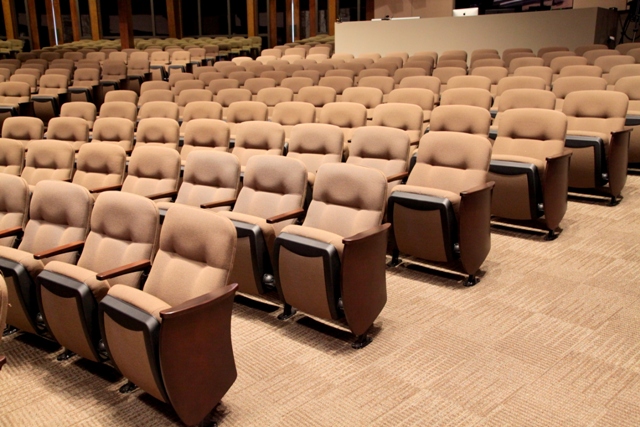
I’ve recently spent a considerable amount of time around people of faith in the South of the USA (the Bible Belt, no less). Church is different there in comparison to the UK. Traditional gothic buildings are replaced with sprawling concert-esque venues. Organs are replaced with full rock bands, including backing singers. Wooden pews are replaced with luxurious cinema chairs (cup holders not included). Stained-glass windows and tapestries are replaced with multiple video screens and dry ice. So aesthetically at least, the US knows how to church. The success continues socially, too: the congregation, where over 500 vibrant and engaged members file in cheerfully, manoeuvre to get the best seats and greet almost everyone else with enthusiastic chatter. At the commencement of the service, they hush to listen intently to a shamelessly charismatic preacher. The sermon is delivered on a theme of the day, littered with anecdotes, jokes, and inspiration. Powerful proclamations are met with sporadic “Jesus Christ!” or “praise Jesus” outbursts. Musical interludes and videos break up the “show.” It was, at once, like the stereotypes, but not like the stereotypes. For me, the whole thing was captivating.

Church seats
Image credit


More than just a service, I attended a Bible Studies class. Bible Studies, for the uninitiated, are like extra-curricular tutorials at school or university, to supplement the lecture—but the subject is The Big Man. Again, surrounded by people with an urge to dedicate even more time out of their week to God beyond the minimum church service, proceedings were hypnotising. I, of course, contributed little in the way of discussion. These were a time for praise and peace, not cynicism, and so I absorbed. I felt that the mellowing was well and truly underway…

There was something quite strange about these experiences. I felt at once relaxed, encapsulated and entertained. Again, I must stress that this was in no way an epiphanic episode, but I guess I was starting to “enjoy the game” a bit more. The most powerful aspect for me, however, was the people I met, who, without exception, were warm, friendly, welcoming, and positive. These were the kind of people who exuded positive energy and passed it on, amongst themselves and even into me. Church in the US seemed like a battery recharge, fuelling people for the week until the next spiritual pitstop. The themes of service, sacrifice and gratefulness are widespread, inspiring a great deal of community action, charity, and goodwill. Finally, I had the insight I should have had years ago about why people believe the way they believe, and the positive influence it can have on life. I felt strangely tranquil.

An atheistic conversion

I’ve often wondered what I’m arguing about as an atheist. Am I a Crusader of Truth, in defence of science and rationality? Am I attempting to challenge a frequent source of oppression in the world? Am I trying to convert people to the relatively meaningless world of atheism? I conclude that I just enjoy a good argument. Even so, considering all the good that belonging to a religion can inspire, would a conversion to atheism make the world a better place? Given my experience in the USA, and the energy that I saw growing in people as a direct result of their belief in something greater, I cannot say for sure that it would. If we, as non-believers, move our focus from the negative aspects of religion to the positive, then we will be in a position to recognise its potential for good in the world.

I probably should clarify why, given the tone of this piece, I am not on my way to a conversion. The basic answer is that, although I am actively trying to support those of faith in their beliefs, I still fundamentally believe that there is no God. Further, I do not feel the need for a belief in God in my life.  Some turn to God for comfort, some for hope, some for happiness, some for purpose. At this stage, my life has plenty of each of these, without feeling like there’s anything missing, spiritually at least. Some, in turn, would say that is something to do with the presence of God anyway. They are, of course, welcome to that belief. I’ve stopped being concerned with what happens in the afterlife, if anything, which can be a criticism aimed at atheists. When questioned about eternity, Ricky Gervais hit the nail on the head in stating that atheists “have nothing to die for, and have everything to live for.” However, as mentioned earlier, no one will ever be able to confirm or reject the existence of a deity, hence my commitment to respecting beliefs which so contradict my own. My experience has been with Christianity mainly, but I imagine the exploration would be similar with other denominations.

The messengers

Remember those two shadowy figures, from the dark street? The young gentlemen I met were indeed lovely chaps (from Japan and Las Vegas respectively, no less). I asked why they had come so far. They told me that God had told them to come to my dreary hometown to help the community here find Him. In my previous incarnation, I may have retorted “well… He’s taking the piss then,” but I resisted the urge. I engaged them in conversation, argument and counter argument to such an extent that they actually said to me “eh, listen dude, we gotta go…” and in a flash they were gone, onto their next (and hopefully less primed) target. I had been so annoying that these saintly messengers from The Big Man had had their tolerance broken. I imagine they are currently writing an identical article to this from the reverse angle…

I wish them well in their quest. I would hope that, should they find success in bringing God to people in the UK, the newfound belief would create a powerful force for good in those individuals. Ultimately, that should be the end-goal for everyone: being and doing good. The source of this good, I feel, shouldn’t be important—atheist, Christian, Muslim or even Pastafarian, I wish them all good luck. I’ll continue to enjoy the game. When the final whistle goes, I guess we all might even find out for sure if there’s a winner.


Suis-je libre? Freedom of speech, freedom of press

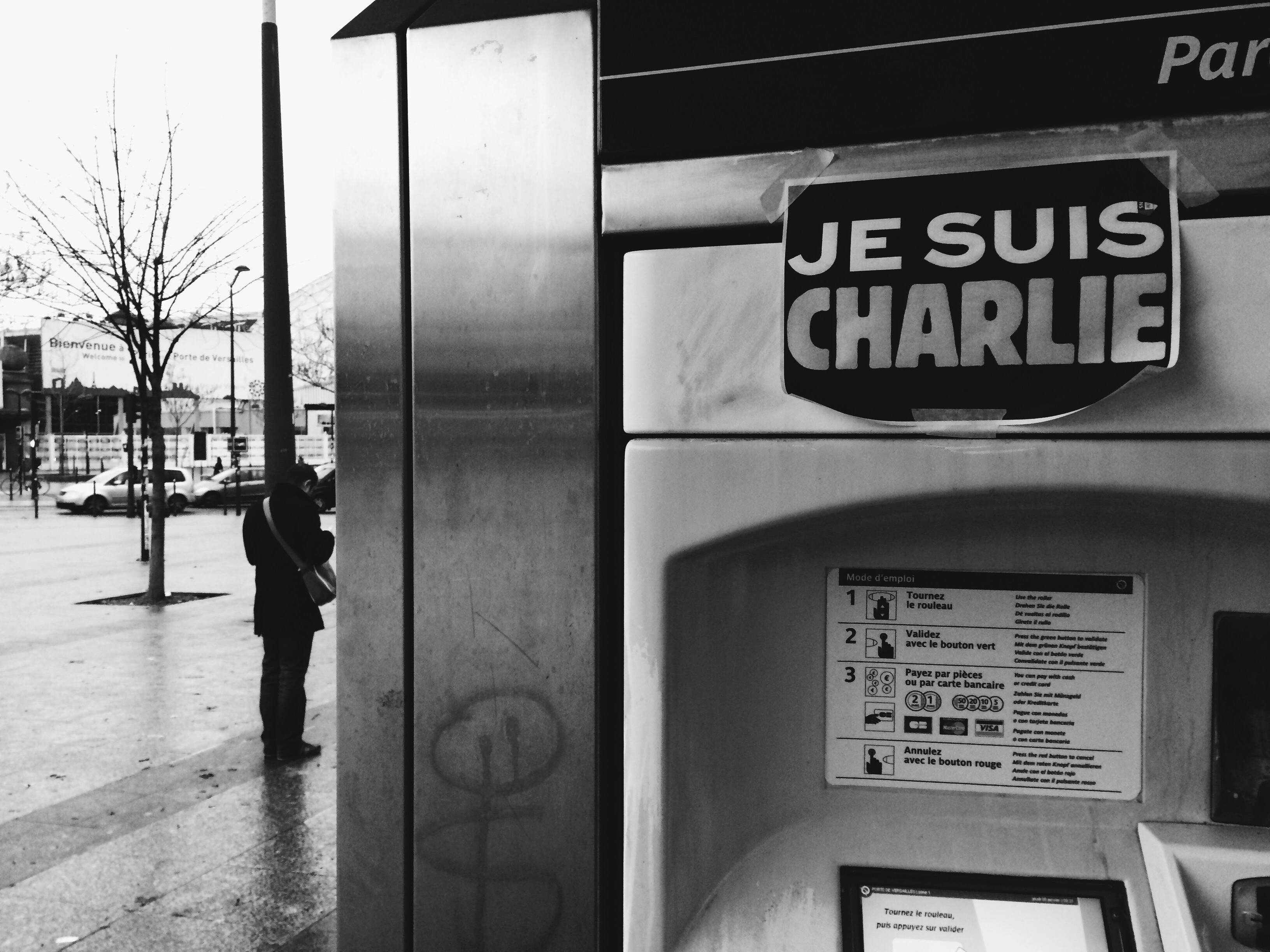
Charlie Hebdo. The name could refer to anyone—a neighbour, a co-worker, a family member, the local postman even—but the moniker has recently taken on an entirely greater significance as the quasi-personification of the right of free speech and the freedom of the press that is enshrined in Western liberal democracy. The banner ‘Je Suis Charlie’ (“I am Charlie”) has been adopted by campaigners as an empowering tag-line reinforcing solidarity amongst those who seek to defend our rights and condemn the actions of those who would seek to oppress it.

The shocking events in Paris in January, where at least 12 people lost their lives in a massacre at the offices of satirical magazine named Charlie Hebdo, were allegedly the latest in an all-too-long line of appalling acts by extremists, attempting to punish and intimidate. The attackers were said to have been shouting “the Prophet is avenged” in response to the magazine’s publication of cartoons involving both the Prophet Mohammed and the leader of the Islamic State, Abu Bakr al-Baghdadi, strongly suggesting the presence of vengeance as an over-riding motive. However, the horrific actions have also ignited a passion in the population regarding the freedom of speech we apparently enjoy in most Western democracies and a desire to unify to defend it.

But the question remains: how free is our freedom? How free should it be?

Legalities

The Human Rights Act 1998, the moral legislative code of the EU, includes Article 10: The right to freedom of expression. Article 10 states that “everyone has the right to freedom of expression,” a potentially simple and emancipating ruling. However, in the subsequent chapter, the right appears to be immediately qualified, “the exercise of these freedoms…may be subject to such formalities, conditions, restrictions or penalties as prescribed by law and are necessary in a democratic society.” So immediately, our beacon of freedom of speech has been blunted in law.

The UK attempts to “prescribe by law” the aforementioned restrictions in Section 5 of the Public Order Act 1986 by criminalising “threatening, abusive or insulting words of behaviour.” Without tackling the legal intricacies, the ruling contains a noticeable subjective element which, on one occasion, led to a conviction of a student for questioning the sexuality of a police officer’s horse… The government is said to have made efforts to repeal this controversial clause of Section 5, but some say that new extremist disruption orders will fill the anti-democratic void.

It seems clear, given the above, that our right to freedom of speech is, at present, qualified. Like telling someone they can run around a shop Supermarket Sweep style and grab anything they want to keep for free, as long as it’s valued at less than £50.

Hate Speech

The reasons for the restricting of this misleadingly universal freedom are important but thought-provoking. A lot of these focus on the prevalence of “hate speech,” the advocacy of hatred based on nationality, race or religion.

One could reasonably expect that allowing people, especially charismatic people addressing an impressionable audience, to espouse hatred against a particular group (or groups) would lead to negative and dangerous consequences. Exposure to highly-charged emotional speech is likely to lead to a similarly emotionally charged reaction from human beings on occasion, and, when adrenaline and passion run high, the result is tragically often violence. Therefore, in an effort to protect society, the authorities have acted to suppress the public vocalisation of opinions which would incite or cause the kind of behaviours causing a threat to public order and safety.

In a debate at the Hart House Debating Club in Canada, a participant offers up the notion that “hate is the ejection button of rationality,” thereby implying that someone who proclaims hate against another group does so because of passion, historical cultural triggers or one-off past experiences, with the absence of rational reasoning. With no way to reason with an individual who is this way inclined, it is argued that the only defence against the spread of hatred and potential tragic implications is to control the source, i.e. the criminalisation of public advocacy of hatred.

Obviously, this is a noble effort, and the UK benefits from a relatively peaceful society where views are offered and exchanged reasonably, on the whole. The primary issue is the inherent subjectivity in the current legislation, and the increase in this subjectivity with every subsequent law. There has to be someone who decides what constitutes an “insult” for legislative purposes, but offence is something that is taken, not given, thereby being unique to the individual. Individuals, including the couch potato’s encyclopaedia, Stephen Fry, have questioned the entire validity of the concepts of insult and offence, though Fry’s comments surely do not assume the extreme consequence of vitriolic hatred as a result of insult.

The late Christopher Hitchens intimated that freedom of speech is comprised of two parts: the right to speak, and the right to listen. He argued that setting controls on what can be spoken deprives the individual of their right to listen, to process, to consider, and to reply. He openly defended the notion of the absolute right of free speech—even for those who lack manners, judgment, and sanity.

With this in mind, we consider the flip side of the coin: freedom of speech is extended without limits.

A controversial debate is the potential for hate speech to lead to positive outcomes. When hate speech is experienced by a society, it allows the opportunity for those in opposition to analyse and critique the opinions proffered, thereby inducing an informed debate. This discourse can be used to bring groups closer together and promote engagement and the exchange of ideas in the process. Once we, as a society, become accustomed and adept at these conversations, there is potential to “build immunity to taking offence” as the comedian Rowan Atkinson infers in his impassioned defence of the Reform Section 5 campaign. Atkinson’s mantra for tackling hate speech is more speech, to tackle an “intolerance of intolerance” which he sees as a false remedy.

Though wholly well-intentioned, this feels like a naive way to view the current situation due to the “rationality ejection” mentioned above. There seems to be very little one can gain through attempts at discourse with aggrieved extremists of any background (illustrated recently in the intense but disturbing documentary, Angry, White and Proud), in the same way little can be gained by holding a white flag in the path of a runaway train.

Free speech is also seen as crucial to an individual’s ability to “self-actualise.” If a person sees the proclamation and proliferation of their views as necessary to achieve their self-actualisation—thus realising their personal potential—then any barriers encountered will naturally be met by frustration, resistance and anger. Whether the un-qualification of full freedom of speech would therefore lead to a happier society where the various goals of self-actualisation are mutually exclusive, though, is debatable. One could think of a sea of irresistible forces meeting a forest of immovable objects.

Utopia versus War of the Worlds

Consider a hypothetical world with no restriction on free speech of any sort. Two opposing extremes could reasonably be foreseen, using the UK as an example:

Scenario 1: War of the Worlds

The UK Home Secretary announces that the barriers to any kind of free speech have been removed, and all opinions, however offensive, disgusting and inflammatory, are passable in public.

Religious and political fundamentalists increase their visibility, holding rallies for their supporters and openly recruiting in the streets. Leaflets, pamphlets and social media denouncing non-believers litter the consciences of public.

In response, groups of nationalists seeking to defend the British way of life band together, holding rallies for their supporters and openly recruiting in the streets. They hold marches to show strength and solidarity, and denounce the religious groups seeking to force their beliefs on the UK.

Young, impressionable minds are drawn to various extreme ideologies, fuelled by the charisma of their leaders and utter-conviction of their principles. Distrust grows. Heated exchanges often lead to violence, with no group willing to give an inch. Rational voices are drowned out by extreme views in the media.

The country becomes divided. A broken society, with cracks becoming crevasses…

Scenario 2: Paradise Found

The UK Home Secretary announces that the barriers to any kind of free speech have been dropped, and all opinions, however offensive, disgusting and inflammatory, are passable in public.

Those who hold extreme views take to the podiums, altars and stages, inciting violence and discrimination.

Society, blessed with a highly educated and reasonable majority, resists the extremism. Inflammatory views are scrutinised, taken apart, traced to their origins, and questioned, both in public and private. Satire becomes a weapon of the masses, holding up poisonous ideologies to ridicule.

Discussions are held. Deep, probing, informed discussions, at work; at home; at school; at the gym and in bars. People with opposing viewpoints from all kinds of backgrounds, thrown together in the UK cultural melting pot, take it upon themselves to address differences and exchange views with each other through reasonable discourse. Community is built across ethnicities, religions and political leanings to build an acceptance of, but immunity from, intolerance. Conditioned from exposure, people become less offended by hate speech, instead their resolution is reinforced.

Gradually, hatred is replaced by rationality, a polite and compassionate acceptance of different beliefs and perspectives.

Which proposed scenario is more likely? Although there may exist pockets of each, realistically society would linger somewhere in the middle.

Freedom of speech

The most important response to the Charlie Hebdo attack then, has not been legislative or authoritarian. The most powerful outcome has been the collective solidarity that huge numbers of people have shown, towards the defence of the right to freedom of expression. But what version of freedom of expression are we defending—the qualified or the unqualified?

Personally, this author would love nothing more than to say the latter, giving any excuse to run down the street reciting Voltaire’s saying of “I do not agree with what you have to say, but I’ll defend to the death your right to say it” to my buddies as they make fun of my favourite sports team, question my political allegiances, or even take the mick out of my parentage (though, it should be noted, even the Pope doesn’t allow this).

But the truth is that this entire debate is not centred on the relatively moderate and secular views and beliefs of myself and countless others. Whatever it is about my upbringing and the development of my beliefs about the world, it is highly unlikely for me to resort to violence as a result of someone else’s words, however disagreeable. The danger, and the reason for control on freedom of speech, is down to those to whom being offended is the trigger for deadly action. Whilst the limit on freedom of speech does not impact most people on a day-to-day basis, it places a restriction in law on those who would encourage violence and retribution against others, or who would encourage persecution of specific groups. This author, for one, will not be dying for anyone’s right to action the aforementioned anytime soon.

The UK is not Saudi Arabia, where Raif Badawi, a pro-liberal blogger, was recently flogged after online criticism of his nation’s government—an act banned by law. We can (and some would say, should) slag off our government. We can publicly state our opposition to the Royal Family. We can even question the existence of a divine entity. All of the above, protected by law, should not be taken for granted. What we cannot do is incite hatred, and that is a restriction on our liberty we should be happy to live with.

This author, for one, longs for a day where the limitation on free speech will be removed. A day where, after years, perhaps decades, of education, integration, and discourse between disagreeing voices carry us through conflict to a social paradise where the UK is free of hatred, accepting of all cultures and beliefs but alive with healthy debate, discussion, and exchanges. The limits on free speech as it stands act in the same way as stabilisers on a bicycle, attempting to control the risk of danger and injury until we are able to ride on freely ourselves as a society, shouting “look, no hands!” as the streets are lined with proud onlookers—an Englishman, an Irishman, a Chinese-man, a Muslim, a Catholic, a Protestant, a homosexual, a trans-gendered person, a disabled person, and many more—all applauding the wonderful achievement to which each had contributed in some way.

With the show of strength, unity, and determination of the people who took to the streets in Paris and around the world to commemorate the deaths of 12 people and support freedom of the press, we can live and hope that this day is not as far away as it may seem. Any one of us could have been Charlie; Charlie would have been proud.

Ships Which Part in the Night: Scottish Independence Referendum

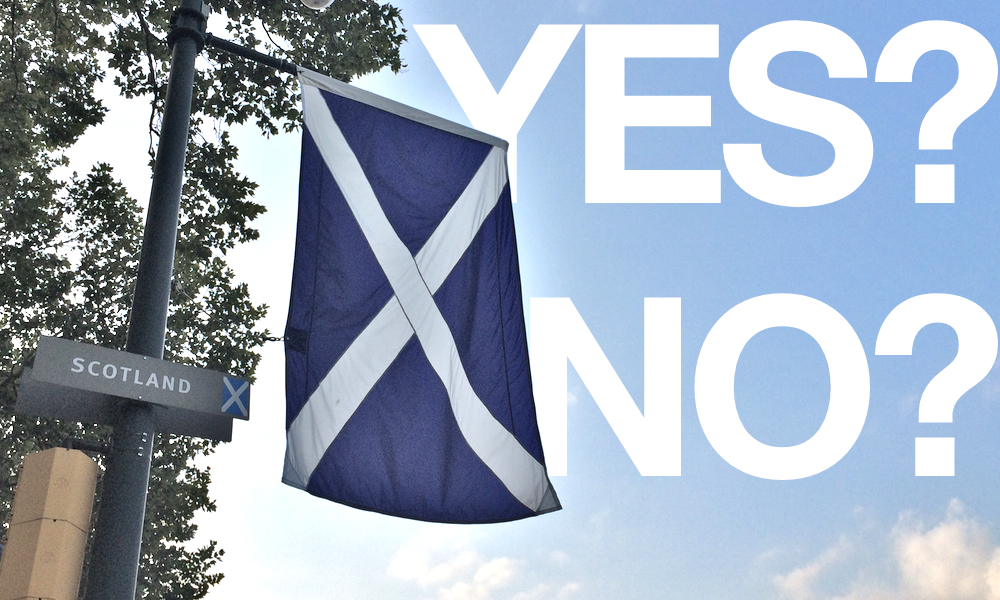
Should Scotland be an independent country? Yes? No?

The 8 most important words any Scot will be considering over the next month before the most crucial moment in over 300 years of proud history. However, is the question broad enough to capture the true mood of the nation at this monumental Caledonian cross roads? More importantly, are the answers?

Rarely can the prospect of a nation’s emancipation after centuries be digested into black and white. What of the areas of grey (grey symbolising both the skies for which our land is famous, and the ambiguity surrounding the future whatever the outcome on the 18th September)? For it seems that, if we were to sieve out the “Mc-stremeists” on either side whose opinions are proclaimed as fact, a large majority of proud Scots would presumably be engulfed by the grey. This author is one of them.

Proud Scotland

Upon being put the killer question of Scottish Independence, quick-fire style, the instinctual response is to think “no”. Scotland, a small country of 5 million-odd proud people, would suffer from the lack of economies of scale that being part of something larger would offer—our voice internationally would be drowned out by the big boys and their bureaucracy. Our relative insignificance would leave us vulnerable in terms of Defence, Immigration, and Economy. We would be marginalised to being a backing dancer in the theatre of world politics. We only have to look at River City, and countless other STV projects, or the infamous Tram system in Edinburgh to see what happens when Scotland is given free rein to manage its own affairs.

However, upon careful consideration, are these assertions accurate? Scotland, in the not so distant past, has contributed significantly (and in some ways crucially) to the shaping of the modern world. We proudly proclaim to have invented world-renowned products such as the TV, penicillin, tarmac, and John Barrowman. Our language and poetry is known the world over, the musical climax to every year in the Western calendar, whilst the founding father of modern economics, Adam Smith, drew his inspiration from Kelvinside. Our cuisine sparks the interest of the world, and drops of 40% alcoholic heaven spread from the Glens into bars across the globe. In the Arts, we can boast a living James Bond, a Dr Who, and a stereotype-shattering singer known simply as SuBo. Even in athletics, our tiny country has produced some the greatest football managers of all time, a champion tennis player, an all-conquering women’s curling team, and even previous rulers of the Elephant Polo world title.

All from a tiny, mountainous country with a population half the size of London.

I think it’s therefore safe to say that Scotland could be an independent country. However, in many ways it already is. Nearly two-thirds of Scots worldwide see themselves as Scottish before British, whilst still holding a British passport. Our culture benefits from a uniqueness and charm largely absent from those of our fellow island cousins. Our accents, fondness for a swally and colourful currency already mark us out from non-Scots. What it is to be Scottish is in no way diluted by our commitment to the Treaty of the Union. We benefit in the UK from being greater than the sum of our parts.

The major downside, however, is the political misrepresentation of Scotland in Westminster, with a Tory-led coalition seemingly as welcome in Scotland at the polls as a fart in a spacesuit, to use a classic phrase from one of our legendary comics. It could also be argued the other way, with Scottish MPs currently using voting rights on English matters.

With all the bluster and conjecture inherent in the debate, it is easy for one to become confused—or worse still, disinterested in one of the most important moments in the country’s history. The situation is exacerbated, there appears to be alarmingly few material facts about Scotland’s future for either side to draw upon. Therefore, let’s simplify everything for a moment.

The High Seas and Scottish independence

Given our island position, and fine naval history, let’s use a shipping analogy. The UK is made up of 4 ships, sailing the ocean. Since 1707, they have been tethered together, each with their own Captain and crew. The Captain of the biggest ship has the majority of the say on the direction and affairs of the fleet as a whole, whilst the other Captains have primary responsibility for their own ships.

The Captain of the Scottish vessel runs a tight ship. His people are happy, healthy and proud and enjoy lots of benefits that the other ships’ crews are not provided. Some say the benefits are paid for by bullion from the larger ship, whilst the Captain staunchly defends his position, maintaining that he gives more pillaged loot to the main ship than is received. Whilst experiencing times of boom and bust together as a fleet, the Scots Captain and his crew often look out into the open water and dream of the wonders that lie in store if they were to break free of the tether.

A dense fog approaches. The Captain has his chance to ask his crew whether he should cut the guide ropes and sail off on his own path. The Captain is adamant in his assertion that his ship is in rude health, and will sail even faster and longer than before on its own.

The Captain of the main ship senses the threat of separation, warning the Scots crew that there will be unforeseen holes in the ship’s hull, the sails are old and withered and the rudder unreliable. He also speaks of the virtues of staying in the fleet, adding that he will give more free rope to the Scots ship if they decide to remain tethered. At that, he leaves the decision to the ship’s resident crew.

The crews of the others ships murmur their opinions, ranging from apathy to irritation at a lack of say in the future of the fleet. The ex-crew members, deposited on various islands around the world to spread the word of the mighty Scots ship and search for bullion to bring back, are similarly unimpressed upon hearing the news that they will not have their voice heard in the future of their ship.

The Scots Captain, overcome with bullish optimism, reiterates his claim that the ship is in fine fettle, denouncing the cynics as traitors and scaremongers. He implores his crew to ignore all others but him as he paints the picture of a fantastical future of wealth, influence and freedom for his crew. The crew is torn between the security of the fleet, and the dream of independence in the open ocean. They enter the fog, with no sign of light, not knowing what the situation will be when the clouds fade…

Yes/No

Flag-from-net-edit

A “yes” vote is an optimistic vote, placing faith in Alex Salmond and his cronies to steer Scotland through the fog of transition and into clear open waters as an independent vessel. Seduced by promises of greater wealth and control of home affairs, the appeal is undeniable. But where are the facts? How do we know our ship will be in good health when all we have to go on is the word of our Captain—his self-interest in his own legacy an important influence on his opinion. A “yes” vote could also lead to us running aground, lost in the vastness of the sea or, worse still, taking on water through the cracks in the hull until we are overcome and have to call for rescue from the fleet.

There is also the small matter of what will happen to the rest of the fleet without the Scots ship. Will they have to change the flags that have flown on the mast for centuries? What of the collective fleet bullion and artefacts—will this be divided? Will crewmembers still be allowed to jump between ships without permission? The importance of the vote on the rest of the United Kingdom should not be forgotten.

The often forgotten aspect of the debate is of the implications of a “no” vote. A “no” vote is not an anti-Scottish gesture by any means, even if the SNP are keen to tar the naysayers with that particular brush. A “no” vote is also not a vote to maintain the status quo—the fact that the referendum is even on the agenda shows that it’s no longer acceptable to the Scots, even to the “no” voters. One thing we can be sure of is increased devolution, a slacking of the guide rope, to continue the analogy. An opportunity would then arise for the Scots ship to explore further on its own, set more of its own rules, and even gain more recognition from the other ships in the sea for its accomplishments. All whilst maintaining links with the UK fleet to allow all 4 ships to prosper together.

The problem is the uncertainty that surrounds everything in this debate, providing an almost insurmountable obstacle for anyone wanting to make a rational, informed decision. The problem shared by many is that the heart says Scotland could be a thriving country in its own right. The head argues that, with no real plan offered by the SNP other than “come on, we’ll be fine,” this is a massive risk. And are we really that disadvantaged by our relationship with the UK? The feeling certainly isn’t of oppression of any sort. The overriding presumption is that the SNP have not fully thought through their plan, seemingly starting the ball rolling on the independence campaign long before thinking through the implications. Therefore, one could conclude that independence is indeed a shining beacon to aim for, but we are not yet ready to take to the challenge on the foundations we have, and with the leadership we have.

Should Scotland be an independent country?

With “yes” and “no” not seemingly adequate answers for my opinion, I would offer the referendum the following answer:

“Scotland should be an independent country, but the decision needs to be based on a comprehensive plan to satisfy the Scottish peoples’ concerns, and not a wave of thoughtless optimism and national fervour.”

The most ironic aspect of all of this—due to my place as a Scot on the crew of the biggest ship in the fleet—the Captain hasn’t even given me an oar in the fight.


Anti-Social Media: Social Media is not Social

Social phenomena rarely affect this author. Rather on purpose, I attempt to stay relatively disconnected from cutting edge technology—somewhat in part due to the fact I am about as useful with computers as Putin at a PRIDE Parade. However, one thing even I have not been able to avoid is the expansion of the all-consuming “social” media addiction. An addiction to anti-social media.

Online Life

How often do we hear the phrase “oh sorry, I don’t have a *insert any popular social media site* page…” anymore? We are suspicious and scarcely believe these people can actually exist when that sentence is uttered, checking over our shoulders for Witness Protection Supervisors or Undercover KGB Agents homing in on their target. Online personal profiles have become almost an obligation at birth—some even creating pages on behalf of unborn kids—becoming a general requirement to appear normal. 74% of American adults are now connected to some form of network. Worse still, an aunt of mine—the most gregarious, friendly and chatty person I know—has recently become addicted to online stalking, often reducing her to a passive, though iPad-wielding, piece of furniture during family gatherings.

But the most disturbing experience I have had with the phenomena occurred with my two young cousins. Two girls aged 10 and 7, they are so bright, energetic, and joyful and have been brought up in a loving environment with a healthy, active family around them. Working means I do not get to see them often, but when the rare opportunities arise I get excited at the prospect of once again spending time with them.

Arrival at their house is met with the usual greeting: screaming, hugging, almost all before the doorbell was released. On a lovely warm summer day, I was dragged into the garden to play with them and their friend from school. In my day (I hasten to add I don’t like being able to use that un-ironically), playing in the garden would involve footballs, tree climbing, making up random athletic challenges and digging holes. Gender stereotypes would not apply at that age, my childhood friends of the opposite sex would be just as muddy and bruised after a hard day’s playing.

However, this time, I was ordered to sit as they fashioned something out of miscellaneous craft items. Handing it to me, I was confused. A piece of paper folded in half with my name on it, inside was a strange grid pattern containing the alphabet… what was this contraption? A shift/caps lock… the picture becomes clearer. Three squares with “Facebook”, “Temple Run” and “iTunes” written on it. My immediate thought was “man, these kid’s games are getting so much more complicated these days…” harking back to memories of classmates making convoluted diagrams which, when matched with a self-picked series of numbers, promised to map out your destiny.

It became clear, I was informed that this was my “laptop” for the day. The girls swiftly whipped out their own multi-coloured versions of the same. So there I was, in the garden on a sunny day sitting with 3 girls whose collective age was lower than my own, staring at paper computers. In a moment of confusion, my next thought was “wait, this isn’t a QWERTY keyboard…”. This was before a sombre resignation began to creep into my thinking.

My unease was not helped by the next part of the day, a role-playing activity where I was to play the new boy at school, complete with new paper laptop and make-shift briefcase (yes, my 10 year old cousin had made me a briefcase wanker). Proceeding to talk in dodgy Californian accents about being “the most popular kids in school” with “a bagillion-million twitter followers,” referring to each other  by twitter names and using “hashtag” in verbal conversation, my cousins were in their fantastical element. Further references to posting seflies with the new kid on Instagram and judging people for “bad tweets” followed, along with a disconcerting yet insightful explanation of how having more than one twitter account allowed more total followers.

By this point I was disappointed. Firstly, because my 7 year old cousin knew more about this than I did. But mainly because, through the brief interactions of that afternoon, I realised the extent to which social media and technology have enveloped the lives of all of us, and none more so than the kids. My cousins were still joyful and creative, but I was very aware of the implication: a developing addiction to “social” media and technology.

Emoticons

That afternoon, I had an insight into how kids no longer value themselves highly on academic and athletic achievement; talents and skills; or the companionship of friends and family. Instead the primary indicator of a successful life at that age has become the number of twitter/Instagram followers, how many “likes” a post about your breakfast gets, or the aesthetic quality of a profile picture. Through uploading content and posts, they can create the ideal image of who they’d like to be, an air-brushed version consistent with the world of celebrity, but not with the real world and real interpersonal relationships. Communication between the children online is free of intonation, so important in developing transferrable skills for the future, and the absence of inhibitions online can lead to harsh words where tact would have been used face-to-face.

Emoticons replace real emotions. A friend and I recently discussed what would happen if everyday face-to-face interactions replicated online interactions, but then realised that we have rarely ever said a sentence before proceeding to wink and/or stick our tongues out afterwards… Instagram is littered with selfies and Twitter is awash with banal proclamations coming from children (and adults…) who do not know any better. There is absolutely a demand for this supply whilst they continue to place so much emphasis on their cyberselves.

Adulthood Similarities


Phone Addiction
Image credit: Victor

Although the effect on children is the most concerning aspect for me, the ill-effects of “social” media addiction is obviously not confined to them. Take a walk around most offices of modern day multinationals, to one of which I belong as a robotic employee, and it’s a similar story. In an open plan office, where you sit no more than 2 metres from another human at any time, all eyes are glued to a screen as if hypnotised. Instant messaging and emails are used where a call or face-to-face conversation are available. We are even being advised to use “professional social networking.” The result? An eerily silent workplace where people tend to have better relationships with their hardware than the colleague across the way.

Don’t even get me started on the scene in any public transport, where people can be blissfully unaware of where they are due to the glue that holds their eyes to their screens. And the less said about checking a smartphone mid conversation, the better.

Adults, too, use “social” media to project the ideal image of themselves, with filtered photographs, well-considered comments and carefully chosen associations. Although the triviality of statements from altogether-too-frequent posters on my own Facebook is mind-numbing. It goes back to the clichés: does anyone really care that you washed your cat? Does anyone want to know that you made too much veg for dinner? If you slept through your alarm or missed your bus, move yourself to work instead of stopping to blurt virtually it blurt out to the world. Any case of people being fired from work or in trouble for causing offence because of a social media interaction will get no sympathy from me, as it should be unfathomable to deny that the process is consider-think-post, and not the reverse.

The worst part of all of this is that it is not a fad. “Social” media is here to stay. Reports may indicate that Facebook growth is stagnating in certain age groups, but it is still expanding and penetrating our lives. Further, like a parasite, it will continue to feed off the demand for more, pervading even more aspects of our life.

Life in 2024

Imagine a refrigerator that posts directly to Facebook what you have removed in much the same way Spotify can show your questionable music tastes: “Dave has just eaten 14 Aero Chocolate Mousses, 2.42am.” Imagine a store that automatically checks you in wherever you go- “Craig was at BOOTS buying CONDOMS and HAIR-REMOVAL CREAM, #expectingabignight.” Imagine a world where humans have lost their natural sense of inner-monologue, and so all thoughts, however inappropriate, mundane or controversial are spurted out into cyberspace as second nature: “Man sitting across from me in the bus is wearing a funny hat #lol #hadtobethere #whythefcukwouldanyonecareaboutthis?.” This already happens.

I am not naïve enough to think “social” media is going to go away. I wouldn’t want it to, as it’s a great way to keep in touch with loved ones around the world, and to organise the odd event (maybe). However, the further we go down the route or reliance on virtual interaction, the more we will lose the real definition of what it means to be “social” as human beings. The success of humans as a species is fundamentally based on our social skills, allowing us to collaborate and problem solve, and to develop relationships to continue the species. We thrive on interaction with our fellow man, learn from them, take great joy from them. Some may say full investment into “social” media is the logical next step for humanity, but I disagree. Is it now acceptable to be “social” by locking yourself in a room alone with your computer on? I think not. We must find balance.

Irony, Venting

Some may also say this is a frustrated and bitter attempt to vent at my lack of technological skills. I might also add in my irrational fear of the plot of Terminator becoming a reality when someone creates something a bit too artificially intelligent #SkyNet.

No. This is a small attempt to highlight a culture that we are all falling into, perhaps without even realising. If there has been this much change for the worse in just one generation between my cousins and I, then imagine where the slippery slope could lead. Visions of family dinners in the future where not a word is uttered, and no-eye contact is made, except with the reflection of self in the smart phone screen.

However I strongly believe that, as a society, we need to ensure that “social” media is incidental to our lives, and not the main purpose. We need to set the example and make this clear, especially for the younger generations. All we need to do is simple: be the change we wish to see in the world.