All posts by Will Compernolle

Will completed his Master's degree in economics from NYU and now works in macroeconomic research in New York City. He is a freelance podcaster and has an exceptional interest in 18th century Scottish economists.

Overcoming our obsession with homeownership

The idea of homeownership is deeply embedded into the narrative of the modern middle class. Owning a home is almost synonymous with controlling one’s own destiny, financial security in retirement, and setting up roots in a community.

For more than a century, politicians have encouraged this mentality and pushed policies that shift people into homeownership over alternative means of residence and investment. In America specifically, this culture has led to imprudent investing, regressive wealth distribution, and a perpetuation of inequality. America needs to get over its cultural obsession with homeownership and the accompanying policies that ostensibly promote it.

Homeownership as an investment

A large house
Photo by Jesse Roberts

In the wonderful story of homeownership, families that plunk down money into home equity over the course of a 30-year mortgage are promised a comfortable nest egg by the time they reach retirement. Encouraging Americans to save more is a worthy goal, but investing in a home often fails to deliver on the storied promise. Putting significant savings into home equity is the equivalent of putting all of one’s eggs into one basket and it’s a basket that cannot move its physical location. Stock prices go up and up over the long term with bumps along the way, so anyone who can ride out the ups and downs will do well over a time span like thirty years. Yet unlike an S&P ETF, a house cannot always wait until retirement to be sold. Families need to uproot themselves and move for a variety of reasons. When this situation arises, they may find themselves in the middle of a down housing market. And as we saw in 2008, housing prices are not guaranteed to go up over time.

Policies are regressive and destabilizing

Agencies, legislation, and fiscal policies have been set up in the name of promoting homeownership. Perhaps the most significant is the mortgage interest deduction (MID). By deducting the interest paid on a mortgage from their taxes, families are incentivized to take out more expensive mortgages than they’d otherwise without the deduction. Politicians sometimes defend the policy as helping the group of people just on the margin of being able to afford a home. This tax deduction, the thinking goes, will give them that extra boost that brings them into that exciting club of homeowners. Regardless of intentions, this has led to American housing policy emphasizing wealthy homeowners rather than those on the border of rental and ownership.
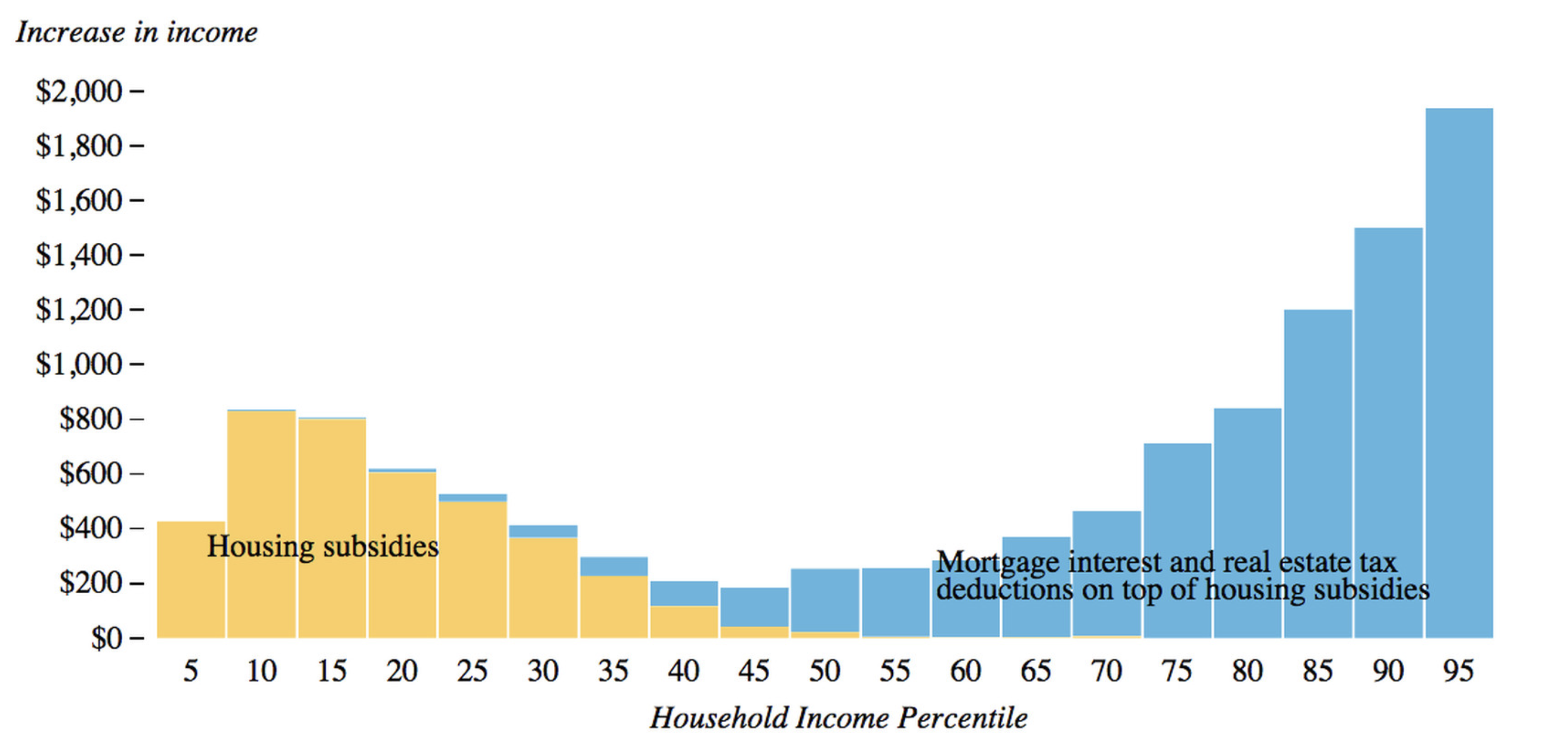
Graph depicting household income percentile
Source: Vox

Policies like the MID also serve to destabilize our financial system. As Brink Lindsey and Steven Teles argue in their recent book, The Captured Economy, current housing policies encourage an over-reliance on debt that makes for a massive house of cards in the financial system. All the while, homeownership rates have barely budged from their 1980 levels.
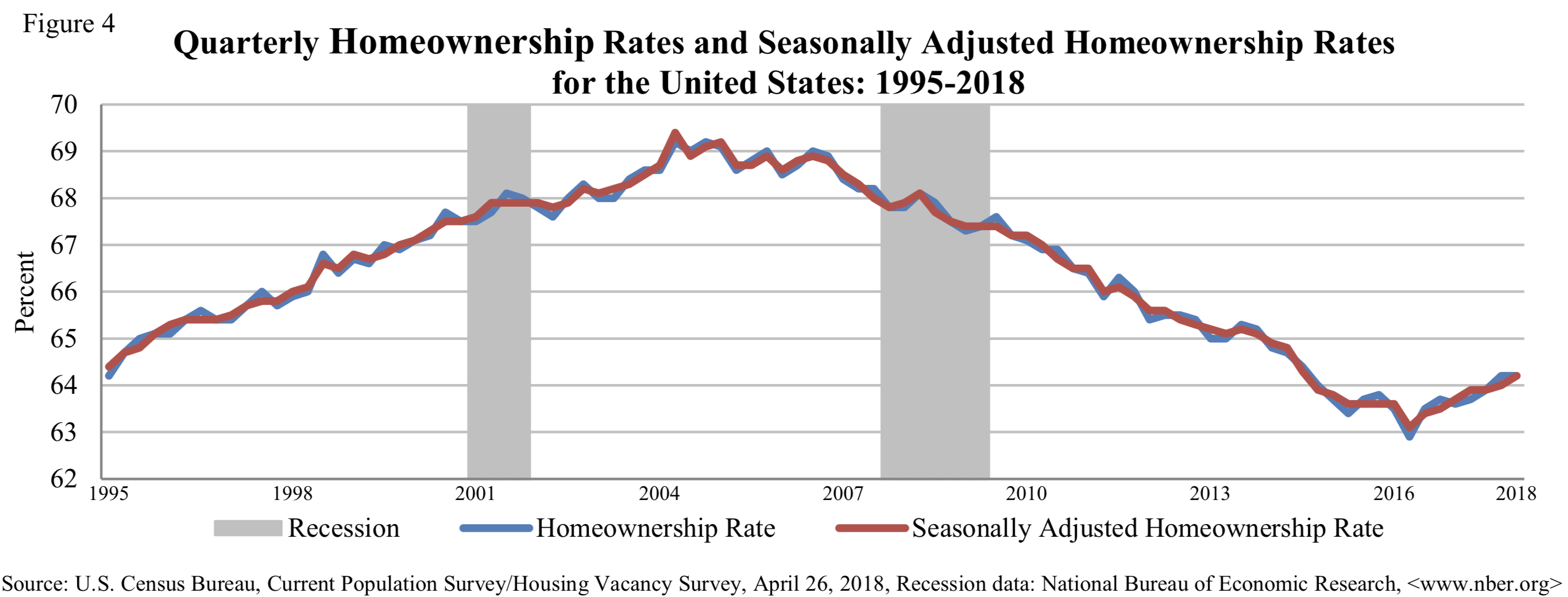
Homeownership rates in the USA from 1995 to 2018
Source: US Census Bureau

Compared to a more targeted policy like down payment subsidies based on applicants’ income, the MID bloats purchases across the spectrum and means even slight moves in the economy can cause a wave of foreclosures. The MID is so embedded in middle class society that it’s a political non-starter when it comes to reform or abolishing a law that almost all economists believe is bad.

Aggravate NIMBYism

By tying families to homes that are immobile and a significant amount of their savings, homeownership pressures people to move heaven and earth to preserve the value of their homes. This perpetuates NIMBY – Not In My BackYard – policies that often serve a narrow group of residents over the common good.

Skyline of San Francisco

When a city like San Francisco sees a massive increase in demand for housing due to an economic boom, construction of new housing is often choked off in part because the existing residents know an increased supply will lower their home values. The residents who would like to live in San Francisco but cannot afford it have no political clout compared to the current residents. Shutting people out of productive hubs like Silicon Valley perpetuates inequality by keeping lower-income people in low productivity areas and giving owners of capital more wealth.

As Mehrsa Baradaran has noted, NIMBYism can drive otherwise progressive people to go to extensive lengths to preserve their home values. Existing homeowners, because of the potential of the policies to lower home values, often vehemently oppose policies that encourage integration of neighborhoods and schools. Although the policies may have uncertain effects on housing values, the risk involved with changing the character of their neighborhood and education system is too great to endure when it comes to their retirement nest egg. The existing public education landscape in America, tying school funding and choice to property taxes and zip codes, is strongly kept in place by a desire to preserve property values.

Every area needs to put undesirable infrastructure like garbage dumps, sewage plants, or prisons somewhere. Because people are so closely tied to the value of their homes, political pressure is placed on politicians to place these structures far away from the highest-value homes rather than what make most sense for the community. Now whether one is a renter or an owner, no one wants to be next door to a toxic waste dump. But the motivation to make sure it’s not in Your Back Yard is much higher when you’re an owner compared to if you’re a renter with much more mobility. Simply put, the risks involved to your property value from any change in your neighborhood can be so daunting that the political equilibrium is just to maintain a stagnant status quo.

Racial Wealth Gap

The racial wealth gap in America today is staggering. The median white household has $171k in wealth compared to $17.6k for the median black household. Matt Rognlie, now at Northwestern University, separated the different kinds of wealth making up the prolific dataset in Thomas Piketty’s Capital in the 21st Century that described the increasing inequality in wealth. For America, he found that housing alone could essentially explain this entire divergence of wealth. If we are going to be serious about narrowing the racial wealth gap, we need to reconsider housing policy in America and recognize that our current policy scheme that claims to encourage homeownership but instead perpetuates NIMBYism and bloats the housing market is a significant contributing factor.

Alternatives

Without an emphasis on homeownership, would Americans stumble into retirement without a nest egg and live in communities where ever-transient families shied away from setting up roots and investing in local social institutions? Germany and Switzerland, compared to the American rate of around 65%, have homeownership rates of around 40%. These countries have different policies and cultures that can substitute for positive effects of homeownership, but they certainly aren’t community-less dystopias or non-saving wastelands. A gradual transition to less ownership and more rentals in America is possible and would improve the finances and social cohesion of the country.

American colleges: the average student isn’t who you think

The image you have of the average American student is probably wrong. Let’s try to find out why: discussions of higher education policy in America are structured around three assumptions: 

  1. A college degree is a necessary ticket to get into the middle class
  2. Debt from college is crippling millennials’ financial trajectory
  3. The existing college landscape perpetuates inequality

Policies typically aim to level the playing field in terms of access and financial hardship. In order to correctly address these goals, several misconceptions about the typical college experience in America need to be corrected. The narrative of an American student commonly depicted in the media is inaccurate and is counter-productive to achieving goals of equity and decreased financial duress.

‘Typical’ American students

The cast of ‘National Lampoon’s Animal House.’ (Courtesy of Universal Pictures)

Reading popular newspapers and watching adolescent hijinks movies, one gets the impression that the median American college student lives in a dorm, graduates in four years, and spends a good amount of time participating in alcohol-fueled debauchery. The years before college are wholly dedicated to gaining acceptance to that elusive elite private university. The time in between school years is spent between the promising unpaid internships and the well-paid summer gig in the big city. The reality, however, is that pretty much none of this represents a “typical American college experience”.

By nature of being in organizations that have mass exposure, the people in Hollywood or those writing for the Washington Post, the Atlantic, and the New York Times disproportionately craft the narrative around what college in America apparently resembles. While not everyone in these industries come from privilege or attended an elite university, it’s fair to say that they are relatively high-performing and many of their peers had similar experiences in college. Their view of college is one defined by four years of self-exploration, graduating with hundreds of thousands of dollars in debt, and a first taste at independence and adulthood.

Actual student profiles

Despite the constant discussion of what’s going on at the Ivy League universities, NYU, Berkeley, or Stanford, more than 40 percent of the undergraduates last year in America went to community colleges. How often does the New York Times do a profile of the student activities or cuts to funding at any community college? More often, there seems to be an article about how more Americans are choosing to study at a particular university in Scotland; while this may be relevant to those in the New York Times newsroom and their social bubbles, we’re talking about a few hundred people a year enrolling at St Andrews. Only 62% of those attending a community college are able to attend full-time, throwing shade on the image of the idle student sleeping until noon. The wild dorm life is less common than one might think as well. Over half—yes half—of American undergraduates live at home during their studies and around 40% work 30 or more hours a week. Although the commonly pictured college student is on the cusp of their 20s ready to freshly face the world, a quarter of undergraduate students are actually older than 25, and an equal number are single parents.

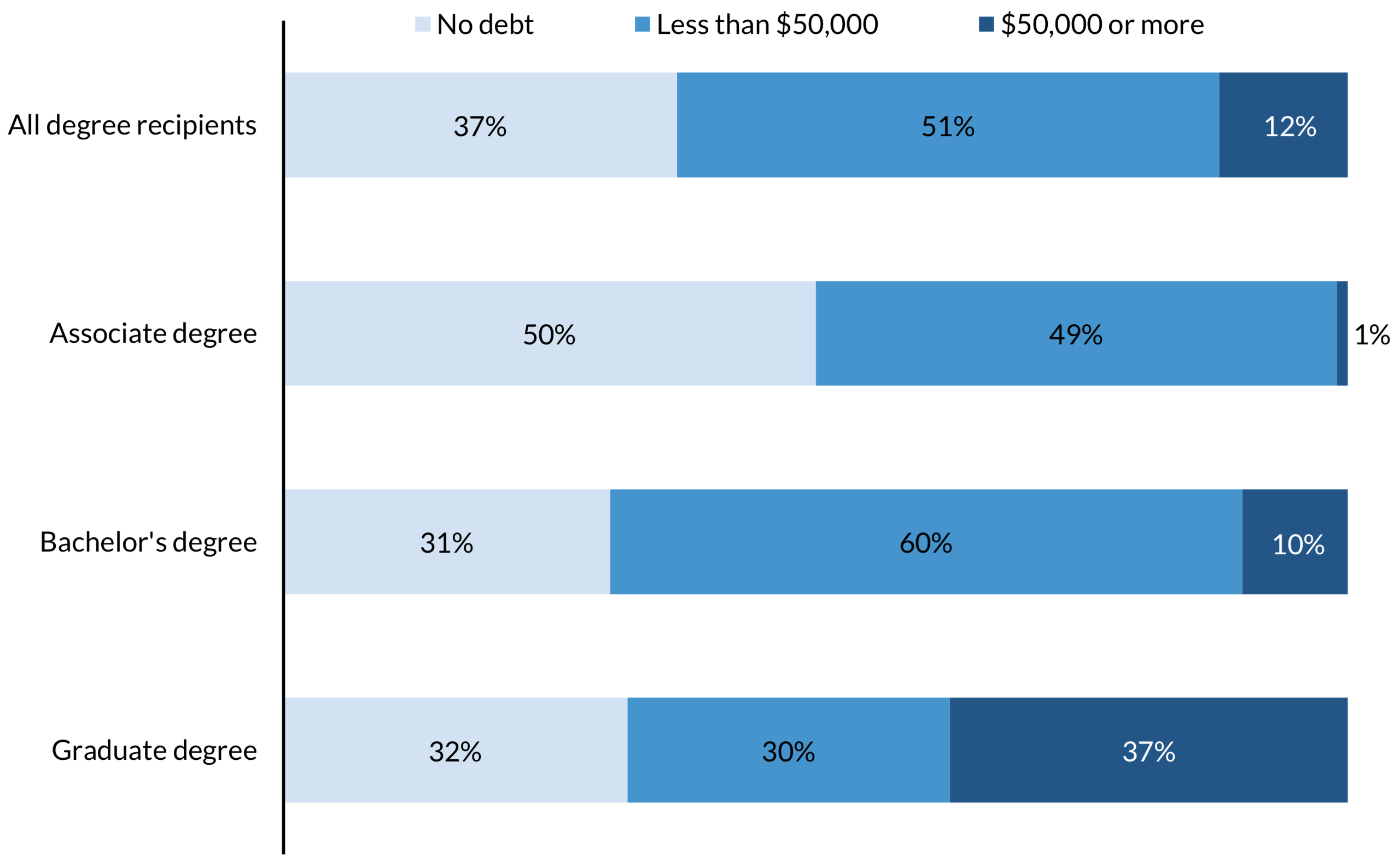
Increasing student debt is placing significant burdens on graduates—and drop-outs—as they enter the labor market and eventually try to buy a home. Of course, any level of debt is a higher burden for students coming from lower-income backgrounds and will discourage prospective students away from studying in the first place. 

Calls to have a student debt jubilee seriously need to consider the profiles of debt distribution. Those who hold the most debt are more likely to come from higher-income families, have additional degrees, and have a much higher lifetime income. 

Deleting all student debt

Debt Is Higher among Graduates with Higher Degrees. Source

Wiping out all student debt, in the simplest plan, would thus be much more regressive than most people realize. Lower-income students at community college would benefit from having their debts eliminated in this hypothetical situation, but most debt relief in dollar terms would actually be going towards people from higher-income families, with high future income, and with less financial burden. Presumably, the taxpayers picking this up means a complete debt elimination would be a redistribution upward. Decreasing the financial burden of lower-income individuals in their higher education pursuits should be elevated as a policy priority: debt relief and support just needs to be targeted based on financial need rather than those with a steadier path to financial security.

Wealthy individuals love to make a philanthropic splash by giving money to build their alma mater a new library, football stadium or dorm. Of the $40+ billion given to higher education institutions last year, nearly a quarter went to only twenty universities, easily less than ~1%. Giving to Harvard to make sure the under-privileged kid can attend without paying tuition is ostensibly a noble cause, but the students that really need help are at community colleges, perennially ignored by the donor class and policymakers at large. The reality is that when elite university graduates give back to their alma mater, it’s more likely to improve the experience of someone from a middle-class background than give an underprivileged student an opportunity to succeed.

Students from Austin Community College
Students. Source: Austin Community College

Stories about typical college life, even outside admissions and tuition costs, on things like “political correctness” again focus on campuses in that Ivy universe where only 0.4% of American students attend. Even among large universities, the actual destinations for most students are ignored in the national mediate narrative. During the most recent academic year, the four universities with the highest combined undergraduate and graduate enrolment were Texas A&M University, University of Central Florida, Ohio State University, and Florida International University. 

When it comes to making glamorous movies or writing dramatic articles about college dreams, the focus understandably can be more centered on elite university life rather than the community college student who works in retail part-time. But if we are going to level the playing field in American higher education and improve the financial hardship of attendance, there needs to be a reality check of what the typical American college experience is. Obvious places to start would be giving community colleges more focus, increasing childcare funding for students who are parents, and redirecting philanthropic efforts towards institutions that serve lower-income students. Without recognizing the typical student experience outside of the private/elite universities, we risk dodging the issue and potentially making it even worse.

Economists need more sympathy

The economic profession lost credibility after the financial crisis, seen by the public as overpromising the certainty and benefits of their models and not properly evaluating the risks involved. Even before Lehman Brothers collapsed, there existed a gap between how economists and how the general public sees the world.

Economic models’ overreliance on rational self-interest as the basis of human nature made their conclusions appear selfish and out of touch with reality. By not embracing a more nuanced view of human nature, economists lack a full understanding of how people behave and risk losing more credibility with the general public.

Economists: the textbook model

Mainstream academic economics is based on models that view individuals as rational utility-maximizers. People are seen as behaving in a way that benefits them to the highest degree given their available information.


Economic evolution

The Max U model is simple and beautiful. Homo Economicus, as it is sometimes called, is the rational economic human, guided only by its desire to maximize its well-being measured by a metric called utility – not exactly happiness, but somewhere close to it. A model is meant to be a representation of reality, so there will inevitably be shortcomings.

Anyone who has lived in a functioning society observes that we are not always guided by selfish reasons. We often try to design institutions that promote justice, we help others in need, and we act morally even when someone isn’t looking.

Looking to not have to re-invent the wheel (and keep the same model…), some economists have tried to explain this behavior by redefining what it means to “maximize utility.” Perhaps I cooperate with you because I know it is to my benefit in the long run. Maybe I help someone in need under the expectation of future reciprocity. Or I give to a charity not because it helps someone else but because it gives me a sort of warm glow. All of these seemingly selfless behaviors could arguably be seen through a lens of self-interest.

Towards more sympathy

Adam Smith, ironically considered the founder of modern economics, had a different view. Human behavior is founded upon our capacity for sympathetic fellow-feeling, not robotic prudent actions. In his book, Theory of Moral Sentiments, he gives instances of fellow-feeling that simply cannot be out of self-love.

When we see a stroke aimed and just ready to fall up on the leg or arm of another person, we naturally shrink back our own leg or our own arm.

Adam Smith

Or when we see a tightrope walker struggle for balance, we twist and writhe as if our own bodies were seeking steadiness. Consider the strong emotions we can have when watching a movie or reading a book. Crying for fictional characters undergoing fictional circumstances is difficult to explain using the homo economicus model. Our tears will not help the characters involved and we cannot expect these fictional people to reciprocate our sympathy for them.

By Smith’s account, there is something inherent and universal in human nature that makes us instantaneously put ourselves in the situation of others, regardless of any potential payoff.

Some economists have recently tried to incorporate this enriched understanding of human nature into their models. Vernon Smith, 2002 Nobel Laureate in economics, has used Smith’s writings to design experiments that show our interactions with each other being more than just transactional.

Behavioral economists like Richard Thaler—also a Nobel Laureate—have tried to incorporate ways people can be “predictably irrational” into models and policies that can “nudge” people in a better direction. The ideas that humans are irrational or sympathetic no longer on the margins, but economists have yet to successfully integrate them into models of the labor market, financial markets, or international trade. There has been progress away from the Max U foundation, but it still dominates economic theory.

Why the lack of change hurts economics

The foundational view of modern economic analysis does a disservice to the profession in two mutually reinforcing ways. First, by failing to acknowledge the sympathetic tendencies of people, economists lose predictive and explanatory power in their models. Additionally, the profession ends up with people who are more likely to see humans as behaving purely through rational self-interest.

Woman holding money
Source: Niels Steeman

In an experiment called The Dictator Game, people are given ten dollars and told they can give an anonymous peer as much of that ten dollars as they wish. In the Homo Economicus model, every person endowed with the ten dollars should keep all to themselves and give none to their peer. The game is anonymous and does not have repetition, so any altruistic behavior can’t be seen as expecting reciprocity or wanting to appear nice in the eyes of their peers. Yet people across all age groups and walks of life show relatively similar tendencies of charity, consistently giving more than zero to other people.

One major exception is economists, who give significantly lower to their peers in these experiments. The explanation is likely some combination of two things but both spell trouble: economists are naturally more selfish people, and studying economics convinces them that this is how we’re supposed to behave. Here on planet Earth, humans don’t always behave as their models suggest.

By relying only on rational self-interest, the economics profession is often met with a reasonable amount of skepticism about its findings. The caricature of the selfish human is not only inaccurate but also deeply unsettling to anyone concerned about morality. It’s therefore easy for the general public to brush aside any findings economists have as unreasonable and not promoting a just or altruistic version of the world. Unfortunately, this means that instances of economics that go against people’s intuitions can be dismissed as heartless.

Rent control is an excellent example where economists believe a well-intentioned policy hurts the poor more than it helps. The laws of supply and demand predict that putting a price ceiling on rent will cause a shortage of available apartments and lead to poorly-maintained dwellings.

These predictions pan out noticeably in a highly-regulated housing market like Stockholm, where more than half a million people are on a waiting list for housing. By mandating rental prices lower than market rates, the government also incentivizes landowners to put their properties on the less-regulated sellers market, further decreasing the supply available for renters and making the shortage problem worse.

Of course, with a wait time of ten years or longer, those in Stockholm with friends or family that already have apartments are able to circumvent this dire situation. This means the few apartments that are available for rent are even more inaccessible to the less fortunate.

Rather than see economists’ views on rent control as a valuable insight into how well-intentioned policies actually work in the real world, the public dismisses their conclusions as being out of a heartless devotion to efficiency and wealth maximization.

Could it be good enough?

It could be that the Max U model is good enough. Newton’s F=ma equation doesn’t apply when considering Einstein’s Theory of Relativity or theories of quantum mechanics. While on planet Earth, however, we’re not going the speed of light and we just want to figure out how to build skyscrapers and bridges. F=ma has gotten physicists pretty far.

Similarly, one could argue that Max U has managed to make economics a powerful explanatory tool, albeit an imperfect one, but there still seems to be overreach with what economists feel they can explain, especially without better incorporating fellow-feeling into their models. A better way to look at it is that, as much as economists want to come up with a “theory of everything” to explain all human behavior, economics probably just doesn’t have all the answers we’re looking for.

Discomfort about the changing modern world that led voters to Brexit and Trump are more likely a sociological phenomenon rather than an economic one. Utility maximization can’t explain opioid addictions or homelessness. In order for economists to regain the trust of the public, they need to have more humility and recognize their current framework is an incomplete view of human nature. Otherwise, issues where they have much more certainty will continue to be met with skepticism from the general public.

The euro is doomed

The euro currency is inevitably doomed. The institutional arrangement is not set up to support a stable currency area and the cultural differences across the eurozone make it nearly impossible to move towards a regime that makes the currency integration beneficial. As countries experience more frustration and powerlessness from giving up significant political and economic autonomy, the arrangement will come apart and the currency will no longer exist in the same form as it does today.

Where’s the fiscal transfer mechanism?

Picture Arizona experiencing a bust in its housing market, a hurricane hitting Florida, or the mines going dry in West Virginia. In each case, the Federal government of the United States steps in to cushion the fall of these economies and their people. Banks might get bailed out, FEMA will dish out aid to rebuild destroyed communities, and medicaid will provide healthcare for those without incomes. The cost of such relief is often too hefty for one state to bear on its own. The Federal Government thus acts as an insurance mechanism so that different regions in the US can spread the risk from negative shocks. Political quibbles inevitably follow about the efficacy and bureaucratic process of these programs. But rarely will you hear accusations of Floridians displaced by a hurricane as “moochers” or recently unemployed rust-belters as “lazy.” Those left unaffected by such shocks living in Massachusetts or California see the people in these states as Americans and recognize that such Federal mechanisms are a part of the American system.

The Federal Government’s ability to take from a general fund of taxpayer dollars and redistribute across different states at different times is called a “fiscal transfer mechanism.” It not only serves as an insurance plan in the scenarios above, but can function to consistently redistribute income from richer states to poorer states. People in Connecticut and Maryland pay more into the Federal tax system than they take out, while states like West Virginia and Mississippi are net beneficiaries of the Federal government. Thus, independent of shocks like natural disasters or economic crises, some states get more from the Federal government and some get less. Political arguments over these transfers are constant, as politicians push for pork-barrel spending that disproportionately benefits their state. In equilibrium, however, this system exists.

Compare this to the eurozone, another consortium of polities with a supra-national power presiding over them. What happens if Italian banks fail or Greece overextends its fiscal accounts and is on the brink of default? Citizens of the countries that have sound banks and followed fiscal restraint don’t have the same instinctual support that Americans feel for their countrymen three time zones over. Germans think Greece’s fiscal insolvency is a self-inflicted problem that involves painful lessons to be learned. People in Ireland look at Portugal’s fiscal woes and wonder why the Portuguese can’t tighten their belts like the Irish did. The eurozone, by design in the Maastricht Treaty that brought them all together, forbids bailouts of national governments. In other words, the fiscal transfer mechanism cannot legally exist. As a result, more often than happens to states in the US, countries in the eurozone are forced to absorb the costs of these shocks entirely on their own, and these costs can be insurmountable.

How different currencies would cushion the blow

Yanis and Schauble
Wolfgang Schäuble, Germany’s Federal Minister of Finance, and Yanis Varoufakis, former Minister of Finance of Greece. Source

European countries survived on their own before they were in the eurozone, so what makes this arrangement different? The currency union itself is preventing smoother adjustment. When a country like Peru experiences a shock like a natural disaster, banking crisis, or garden variety recession, the weaker economy naturally weakens its Sol currency. This in turn causes Peruvian exports to become more competitive and the economy is on the road to recovery. Peru’s central bank can lower interest rates, too. This encourages more investment and gets the engines of the economy pumping again. However when Italy reaches high levels of unemployment, its currency doesn’t weaken in step with Italy’s economy. The exchange rate of the euro is tied to the eurozone as a whole, of which Italy is only about 10%, and Italy can’t lower interest rates to ramp up investment. The short-term interest rate is set by the European Central Bank which is set by bureaucrats all across the zone. So an Italian recession is accompanied by a stronger-than-should-be currency and interest rates that are higher than they would like.

Economic integration will help…in theory

Labor mobility is another way an economic area moves towards equilibrium when certain areas are hit harder than others. Here, the legal framework for the eurozone works in its favor. The Schengen Agreement allows for Schengen Zone citizens to work anywhere in the Zone, no matter their passport. This means that if Spain has a high number of unemployed workers, some of them can go over to Austria where the labor market is a little healthier. The shock is absorbed by Austria and things reach a happier equilibrium. When midwestern states in America experienced decline from fewer jobs in manufacturing, people headed to sun belt states like Arizona or Texas that have more opportunities. So why isn’t this happening in the eurozone?

Moving from Ohio to New Mexico is much easier than moving from Spain to Austria. Crucially, English is the dominant language in any American state. The cultures of different areas in America may be distinct, but they’re peanuts compared to the differences of countries in Europe with thousands of years of history that form their identities. What if a Greek with little formal education wants to move to Austria… What are the odds they’ll know German? The stigma against workers from lower-income countries like Poland or Bulgaria often make it difficult to find work in France or Belgium. Xenophobia within the eurozone discourages labor mobility that would other equilibrate labor markets more smoothly.

If labor mobility were perfect in the United States, people in West Virginia would be moving to places like Massachusetts, Texas, Silicon Valley, or North Dakota. Moving is tough. People set up roots, form communities, buy mortgages, and get used to local norms. It’s not as easy as packing up one day and leaving the next. Throw in cultural and linguistic barriers to this and the eurozone labor market is not nearly as integrated as it is in legal terms.

Europe is not the United States

The United States doesn’t have perfect harmony across the country, of course. Historically, national harmony was incredibly difficult. Since the founding of the country, there has been a constant push and pull between states’ rights and giving more power to the Federal government. The campaign towards states’ rights is founded on the idea that states have different beliefs and should be able to operate with a high level of autonomy. Heck, there was even a war fought over a critical disagreement that took the lives of over six hundred thousand Americans. And, in many ways, those two sides still remain divided via other ideologies one hundred fifty years later. Simply put, the United States got to be where it is today after more than two centuries of friction and it wasn’t easy. Even with all that, it benefitted from having tremendously more linguistic homogeneity than Europe has and it didn’t have millennia of regional identity baked in to individual identity. Furthermore, Project Euro has attempted to expedite this tough process of integration and identity in a mere 17 years. Having eurozone citizens suddenly consider themselves “European” before considering themselves “German” or even “Bavarian” isn’t going to happen anytime soon.

The unstable equilibrium

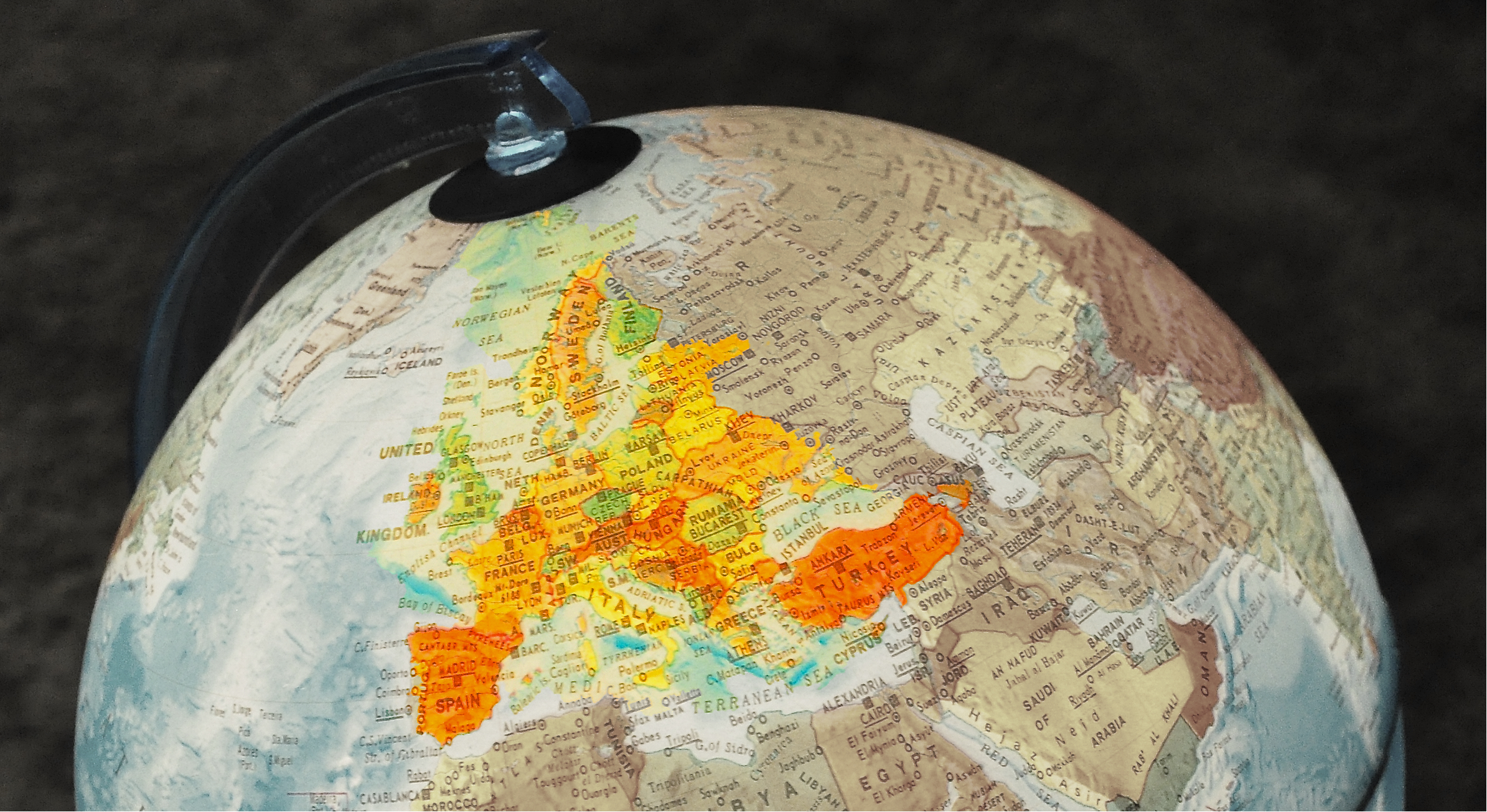
Globe with europe highlighted
Source

The only solution to the eurozone’s problems is More Europe. That means a more-powerful European government that can provide a fiscal transfer mechanism and a move away from national identity and towards a European one. The first part can be done politically, the second is left up to the people. If the eurozone moves in a direction of nationalism and isolation, its problems will persist and only get worse. Right now, the zone is a house of cards ready to collapse into Less Europe unless it can search deep down for the political capital to give it the strength it needs to stay together.

The result of the Brexit referendum in June, while not technically involving the eurozone, reflects the tension of the struggling European identity. Brits felt they were giving too much to the European Project and decided to go down a path that emphasizes national identity more than integration. The unfulfilled promises of a more-integrated Europe were disappointing enough to have Britons call it quits. As Germans and Greeks increasingly resent each other’s norms, convincing either side that the solution to their problems is more integration is near impossible.

The reforms needed to keep the eurozone intact are dramatic and especially difficult to pass in a stagnant economy that’s dealing with millions of refugees knocking at the door. While the eurozone may make the necessary changes, time is running out. The political climate is shifting strongly towards Less Europe, and once the direction gains momentum, it will be difficult to ever turn back.

Ignore Brexit and Trump, we’re better off than we used to be

The strong current of populism in high-income countries in the last year has taken many by surprise. An unexpected victory for the Brexit campaign and a shocking level of support for Donald Trump’s Presidential run are among the recent political events that show a drastic turn away from cosmopolitanism and towards nationalism.

Everyone is trying to make sense of these phenomena, blaming whatever aspect of international policy trends that will prove their previously held ideology. The racial aspect and a resistance to multiculturalism could be viewed in hindsight as a significant catalyst for this sentiment. Perhaps the most popular explanation right now is the economic one: so-called neoliberalism has made a few rich at the expense of the working-class and this surge in populism is a revolt after being ignored for so long.

Whatever legitimate economic anxiety Brexiteers and Trumpkins have from the last few decades of increasing globalization, it is dwarfed by the historic rise in living standards nearly everywhere else in the world.

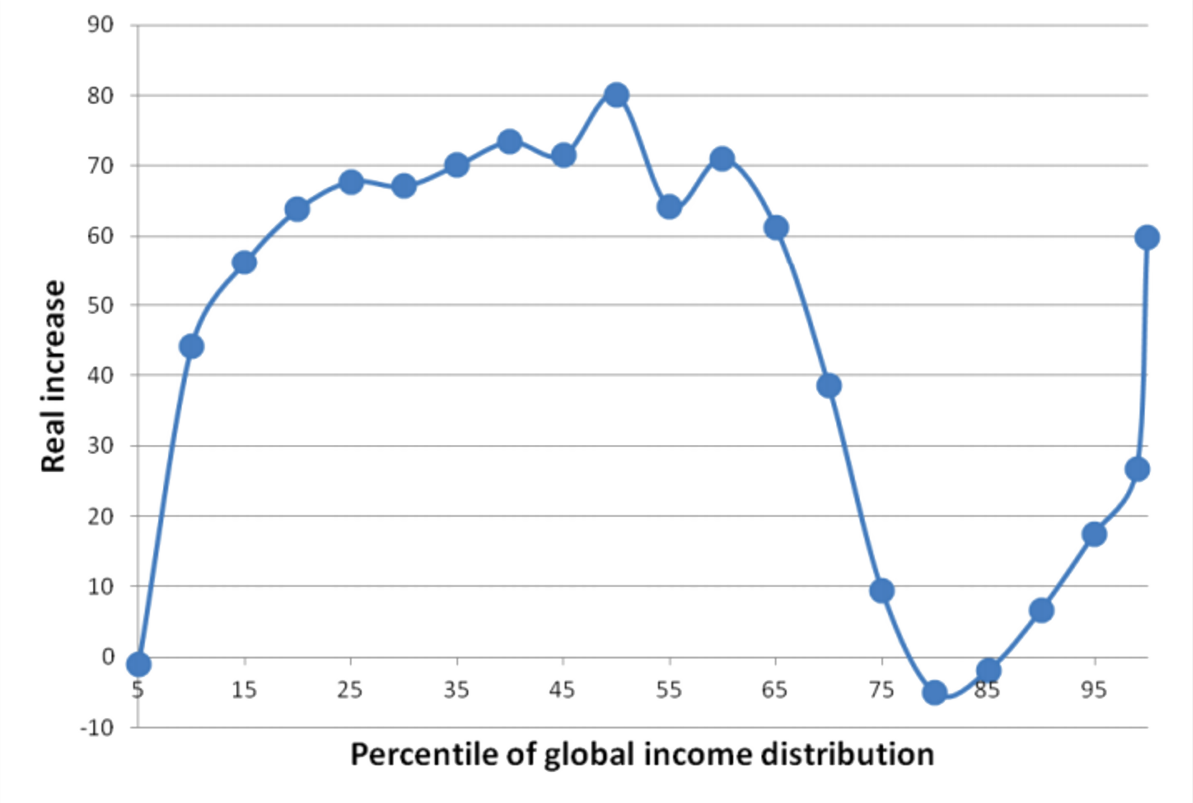
Elephant graph
Source: Bloomberg

Take a look at the graph above. A quick check on the internet will reveal slightly different permutations of it: maybe a different time period, an emphasis on certain countries, etc. All of them have the same message: the last few decades have seen incomes rise for the vast majority of people across the world.

The Good News

The quick way to interpret this graph is that the poorest 77 percent of the world—the first three quarters of people starting from the left-hand side—have, on average, seen their incomes drastically increase between 1988 and 2008.

Everyone above the 85th percentile has also seen their incomes rise. Consider that, during this time period, more people escaped poverty than the rest of human history combined. The oft-vilified globalization, characterized in popular discourse by sweatshops, environmental destruction, and greedy multinational corporations, has coincided with bringing 320 hundred million people out of poverty.

The time period and its policies or corporate behavior are not without flaws – climate change being an obvious and urgent downside. But if one is to only look at the economic outcomes, this time period did more to lift the standard of living of the bottom 75 percent of the world than any other period in history. Was it because of globalization or in spite of it? Of the 320 million that escaped poverty during this time, 270 million were in China. China’s general trend post-Mao has been a gradual embrace of markets and opening itself up to trade. China is experimenting with its own flavor of capitalism, there’s no doubt that its embrace of international trade and markets is the underlying cause of their tremendous growth during this time period. In other words, aspects of what anyone would include in their definition of globalization are at the root of the country growing the way it has.

The Bad News

Notably, there is still five percent of the global population—the poorest five percent—that have not seen their incomes rise during this time. These people should not be ignored in global policy arguments, but how to lift the material well-being of that income group is a separate conversation. For now, focus on the eight percent of the world population who consider themselves between the 77th and 85th percentiles, whose incomes have seen a slight dip. This group of people can be considered the working-class in America, Britain, and other high-income countries. Assembly line jobs that used to be able to support entire families are now being competed away by a combination of cheaper labor overseas and more efficient machinery. So far, the gains of globalization and technology have increased the affordability of every good and service this group can buy, but not the wages many need to purchase them.

In a sense, we can think of the “Western working-class” being pushed aside by an “Emerging Market working-class.” Emerging market economies like China, India, Brazil, and Indonesia are building their own middle classes, simultaneously lifting hundreds of millions out of poverty and displacing the Westerners that used to do that work.

The Political Reality

As demand has shifted more to labor in these emerging markets, the Western working-class of yesterday has seen their wages go down. As the graph illustrates, the high-income earners in the world have seen their material well-being go up over the same time. This has indeed increased inequality on a national scale in high-income countries. However what is less appreciated is the decrease in global inequality. The massive increase in the purchasing power of the average worker in the bottom 77 percent has made the difference between the gold-yacht billionaires—or even your typical middle-class American suburbanite—and the median Indonesian significantly smaller.

If we could increase the standard of living for everyone without any rough adjustment period, we would and it would be our best option. The alternative, the era of increased globalization, offered a regime that increased the well-being of maybe 90 percent of the global population. Remember that the 77–85ers are still in the richest quarter of the global population. I imagine a global vote on the 1988-2008 international order would be mostly favorable.

In reality, the current marriage of national sovereignty and electoral democracy means that only citizens of a given country will vote for its leaders and policies, even if every country’s political landscape increasingly spills over into the rest of the world.

This means that the 77-85ers, generally being citizens of Western democracies, are, in a sense, overrepresented in the voting electorate. They represent a significant share of voters in high-income countries that, for the time being, play a powerful role in geopolitics and international economic affairs. With decisions like Brexit and the success of Trump so far, they are shifting international politics in a direction that reflects their economic conditions more than global economic conditions.

The last few decades of increased globalization, technology, and trade have not been perfect. The system is sub-optimal in some ways through things like corporatism, unfair intellectual property enforcement, and environmental degradation. Yet, through all of this, hundreds of millions of people have escaped poverty. Those in the global 77–85 percentile feel they have been left behind. Some of this may be racial resentment or general fear of change. From an economic point of view their struggles, while legitimate, need to be placed in the greater global context during the last few decades. Rather than dismantling the current system and replacing it with protectionism, nationalism and xenophobia, a preferred remedy would be to assist the 77-85ers within the existing system.

What’s the solution…more emphasis on education and skill-training? More progressive taxation? It’s not obvious what the most effective or cost-efficient policy would be. But before we upend an economic order with unparalleled ability to lift people out of poverty, let’s appreciate the phenomenal gains of the last thirty years.

Don’t Blame Dilma Rousseff for Brazil’s Woes

Brazil’s economy in the last 15 years is a prime example for how we tend to unfairly ascribe massive political events to individual leaders. On the 12th of May 2016, Brazil’s Congress temporarily suspended sitting President Dilma Rousseff while they bring charges against her related to alleged manipulation of the public budget.

While Rousseff may be guilty of fudging treasury accounting, her crimes are minor compared to most others in Brazil’s Federal government: half of said Congress is under investigation for involvement in the so-called “Car Wash” scandal, where politicians traded government contracts for massive bribes. The interim President, Michel Temer, stinks of corruption to the point of being disqualified for re-election in 2018. A leader of the charge against Rousseff, Eduardo Cunha, resigned from his position as House Speaker earlier this week under allegations of corruption.

Opinion polls showed strong public support to remove Rousseff from office. Why? Brazilians are suffering in an economy that has shrunk more than 7% in the last two years. They want a scapegoat. Although any honest appraisal of the political situation in Brazil would show Rousseff relatively innocent compared to her colleagues, the citizens are looking for someone to blame.

On the surface, Rousseff was an inept politician that drove her country into financial turmoil through mismanagement and unwillingness to get spending under control. But in reality, the country’s nosedive is the result of forces outside of her control.

Brazil: 2002-2016

Dilma Rousseff and Luiz Inácio Lula da Silva

Luiz Inacio Lula da Silva, better known as “Lula,” ruled as President of Brazil from 2002 until 2011. Lula left office with sky-high approval ratings and was praised by President Obama as “the most popular politician on earth.” Lula came from incredibly modest roots in the poor northeast of Brazil and successfully led his Workers Party (PT) in efforts to dramatically redistribute wealth in Brazil. A global commodity supercycle timed favorably with Lula’s rise to power: commodity prices tend to be cyclical and they happened to be high during Lula’s reign. When the stuff Brazil was selling to the world—iron ore, oil, soybeans, corn—became a lot more expensive, Brazilians became richer. This also meant Brazil’s government had more money to spend on things like healthcare, education, and pensions. The music eventually stopped and the Brazilian government couldn’t afford to hand out as many goodies. The promises made by the generous social welfare system put into place during the commodity boom remained after Lula left office.

Enter Dilma Rousseff

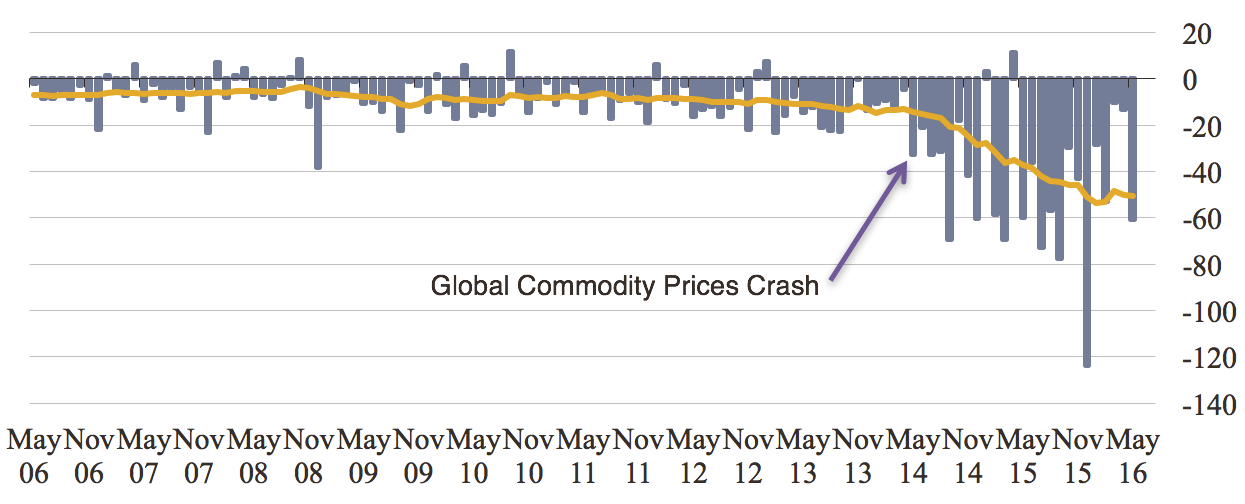
Dilma took power in 2011 with Lula’s economic boom lingering. A growing Brazil looked poised to join the ranks of other emerging market economies like China and India that were on the verge of competing with the West. Brazil locked in the World Cup in 2014 and the Olympics in 2016. But in the middle of 2014, when commodity prices started to crash, Brazil’s economy stalled and began a downward trajectory it has yet to recover from two years later. Today, Brazil is set to shrink for a second consecutive year, faces nearly double-digit percentage increases in consumer prices, and has public finances on an unsustainable trajectory.

From the perspective of the casual onlooker, the respective legacies of Lula and Rousseff are simple: Lula led Brazil to roaring growth and took millions out of poverty; Rousseff was an inept politician that sparked Brazil’s downward spiral.

But look closer at the causes of Brazil’s economic performance during the two’s rule: Lula held office at a time when commodity prices were soaring. Nearly half of Brazil’s exports are commodities. The world economy was stronger in the 00s than it is now, meaning other countries had more money to buy the stuff Brazil was digging out of the ground. Rousseff survived one term with decent commodity prices but was in power when the price of iron ore and oil fell 67%, corn lost a quarter of its value and soybeans cheapened by nearly half. These underlying conditions had nothing to do with either Rousseff or Lula.

Brazil’s Problem #1: Struggling Public Finances

The most urgent issue facing Brazil is its public finances. Unfortunately, a legacy of yesteryear in Brazil is that around 90% of government spending is ring-fenced from Congressional discretion. It takes constitutional amendments to change the formulae that determine spending on pensions, healthcare, and education. This means that when Brazil’s economy has shrunk by nearly 7% in two years, the government has its hands tied when it comes to any necessary belt-tightening. If you think it’s hard to take away people’s entitlements in good times, what do you think the political popularity of pension reform is when everyone is already 7% poorer?

Graph of Brazil's Public Sector Balance
Brazil’s Public Sector Balance, Billions of $R (Yellow line: 12 month moving average)

The annual deficit as a percentage of GDP has gone from 3% to over 10%. As the situation has deteriorated, creditors feel like lending to Brazil’s government is riskier. So interest rates go up and borrowing becomes more expensive… the vicious cycle deepens.

By having direct stakes in commodity-producing companies like Eletrobras and Petrobras, Brazil’s government loses financially when these companies struggle. Not only do those companies’ struggles mean less tax revenue—standard in a recessionary economy—but the losses on the books of those companies translate into losses of the government. In other words, Brazil’s government is forced to subsidize failing companies.

Brazil’s Problem #2: Price and Wage Indexation

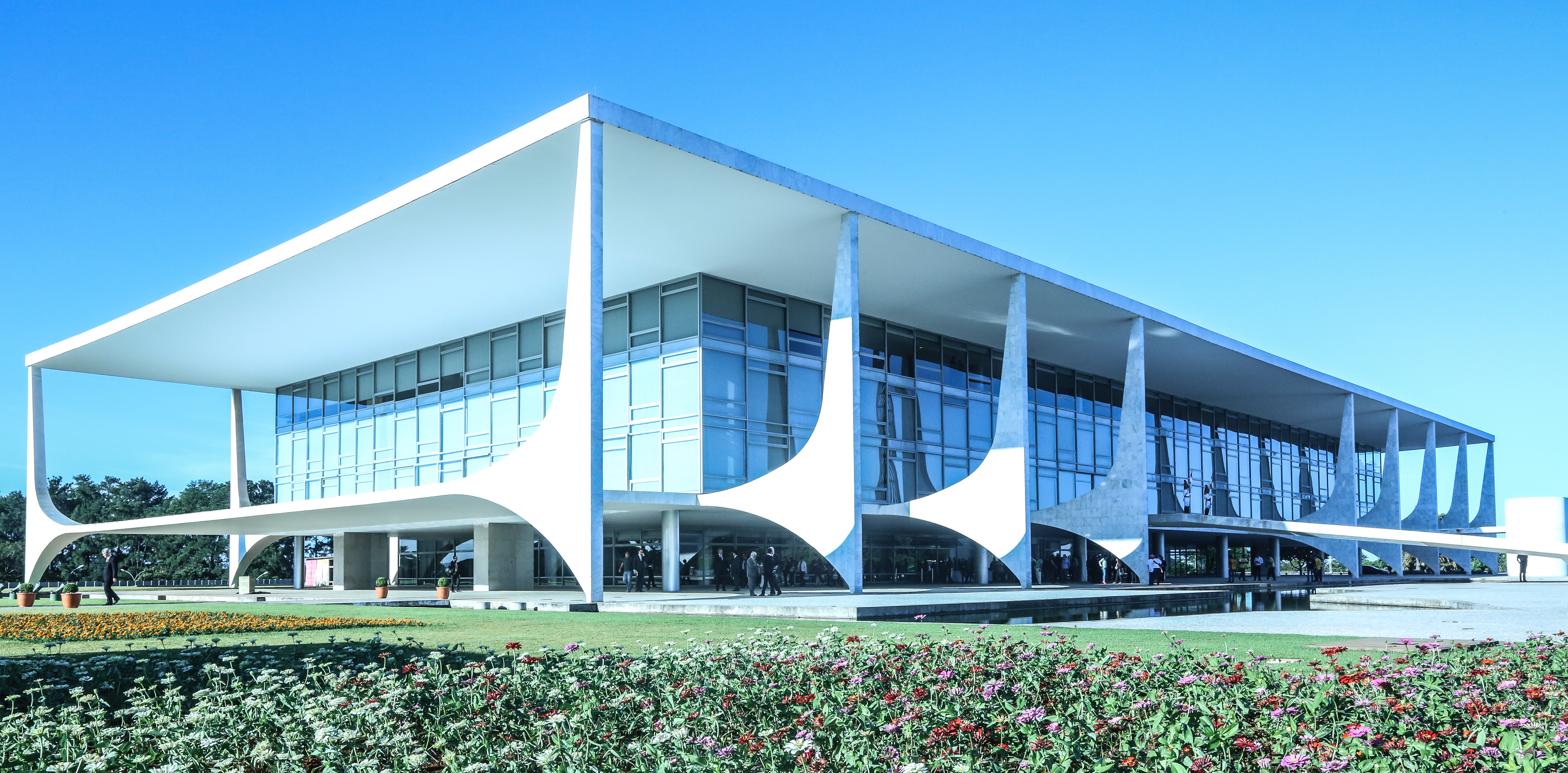
The government policies that made Brazil’s adjustment to lower commodity prices as painful as it has been were set in place long before Rousseff took office. A huge chunk of wages and prices in Brazil are indexed to inflation from the previous year, meaning typical remedies to simmer price levels like higher interests rates or lower aggregate demand are virtually ineffective. Sky-high interest rates (14.25% in Brazil whereas higher income countries have had interest rates near or even below zero in the time since the financial crisis) aren’t expected to get consumer prices down to their targeted level for at least another year and a half. The stubborn persistence of inflation in Brazil is around regardless of any strong will or intelligence from the one who resides in Palácio do Planalto.

Palácio do Planalto: official workplace of the President of Brazil

The collapse in commodity prices hit Brazil’s currency that set off the bout of inflation. As demand for its exports tanked, the demand for its currency fell, too. The falling value in the Brazilian real resulted in a 50% depreciation against the American dollar in the last couple years. When the country’s currency can buy less abroad, its imports get more expensive. This set off the spike in inflation seen in the last two years.

Inflation is bad in any economy because it causes “noise” in the price system and discourages long-time planning that is strongly tied to economic growth. But it is exceptionally painful for Brazil because their minimum wage is derived from a formula based on last year’s consumer price index and GDP growth from two years ago. In turn, pensions—which make up a little less than half of Brazil’s public budget—are indexed to the minimum wage. Inflation from last year begets inflation this year in a vicious spiral.

The problems that leave Brazil struggling to recover from its latest bust are derived mostly from policies and events completely out of the control of Dilma Rousseff. Similarly, solutions to speeding up a recovery are not within the power of interim President Michel Temer.

Beyond Brazil

Beyond Brazil, political leaders are given blame or credit for their countries’ performance that far exceeds their true influence. In order to assess the true impact of a leader, one must tease out the vast array of events that happen outside of a leader’s control. A paper from William Easterly and Steven Pennings found the relationship between leadership and economic growth to be very weak, after controlling for variables across time and space. So-called ‘benevolent dictators,’ like Singapore’s Lee Kuan Yew, get credit for their countries’ economic performance, but how much of it really had to do with leadership?

The tendency for observers to attribute events to a single leader or small group comes from the appeal to simplify our enormously complex world. If the world’s ills are the result of billions of people behaving in a decentralized manner without conscious intentions of bad results, changing the system seems frustratingly difficult, if not impossible. But if the world is governed by a few small elites, changing the world’s problems seems within our power. Brazilians are much more likely to be drawn to an explanation/solution of their problems that relies on regime change than one that is frankly out of their control. They don’t have the power to vote commodity prices higher and the institutional changes that are needed are, by design, difficult to implement.

The point is not that policy and politics don’t matter. Brazil’s woes after the commodity price crash two years ago have been exacerbated by policies that institutionalized inflation and made necessary fiscal adjustment nearly impossible. The inefficiencies from corruption certainly don’t help either. Instead, rather than ascribe economic performance to omnipotent individuals, we need to recognize that the world’s complexities mean our problems and solutions do not always come from the top-down.

The Economics of Festivus

In a season 9 episode of Seinfeld, George’s father Frank resurrects a holiday from George’s childhood called Festivus. Among other things, Festivus rejects the gift-giving aspect of many holidays. Frank Costanza may have been onto something.

Around Christmas time, the media will report excitedly that a certain amount of money has been pumped into the economy because of higher consumer spending. While this dollar estimate may seem like only good news, looking behind the numbers reveals a less rosy picture. The gift-giving surrounding Christmas and other holidays can be viewed as a loss in value to society from an economist’s point of view.

Festivus Pole from Seinfeld

Consumer Choice

Anytime you go online, go to a store, or browse through a shopping magazine, you decide to buy something only if you value the item(s) at equal or more to the price you’d pay. If you think you could spend the $20 for a widget on better things, you wouldn’t buy the widget. Yes—you can buy impulsively, be under the influence of an illicit substance, or act in an otherwise irrational manner. But generally speaking you’re only going to buy that $20 widget if it’s worth $20 or more to you. This seems self-evident. Less obvious is that how much you value the widget isn’t widely known public information.

When someone goes to buy a gift for you, they’re taking an educated guess at how much you value an item. They have imperfect information about how much you value something. They could be buying a $20 item that you actually only value at $10. That $10 difference is what economists call deadweight loss.

Evidence

Joel Waldfogel at the University of Pennsylvania surveyed different populations to find out the difference between the cost of gifts people received and how much they valued those gifts. Waldfogel found that in general 10–33% of value is lost in gift-giving transactions. Because of this massive amount of destroyed value, Waldfogel has referred to Christmas as an “orgy of wealth destruction.”

How much that difference is correlates highly to the magnitude of imperfect information. The people who know you the best have the best sense of how much you value things. On one end of the spectrum, you have someone’s spouse or significant other. This person is most likely to know the gift recipient’s interests, needs, and daily routines. There is likely the least amount of imperfect information in this case and the lowest amount of wealth destruction. A step down from this is close friends and family; they know the recipient fairly well but there’s still more room for over-valuing a gift. On the other the end of the spectrum—where value goes to die—lies the office Secret Santa exchange. In this scenario people are compelled to buy gifts for people they barely know. The overall lesson, from an economist’s point of view, should be to minimize the level of gift-giving on this end of the spectrum.

Not all economists agree with Waldfogel’s idea of Scroogenomics. People give gifts for reasons other than purely utilitarian ones and these shouldn’t be dismissed. Sentimentality—“it’s the thought that counts”—is of course a significant value in many exchanges. But this sentimentality is partially captured in Waldfogel’s surveys. Additionally, there’s a positive correlation between the level of sentimentality and the accuracy of the gift-giver’s valuation; a gift from a spouse will mean more to the recipient than a gift from the randomly assigned office co-worker.

Gift-giving is also a method of ‘signalling’ a giver uses to show the recipient how much he/she cares and well he/she knows the recipient. The diamond ring shows the level of love the giver has (apparently?) for the recipient but more importantly the choice of ring is a signalling device to the recipient as to how well the giver knows him/her. Signalling then could be a value of gift-giving Waldfogel fails to quantify in his results. Or, an argument could be made that it’s an explanation for why we give gifts the way we do today, even if there are much better ways to signal to others how much we care for them.

Larger Implications

Money is the closest gauge we have to putting a number on how much we value something. But spending $20 on digging holes just to fill them back in again doesn’t mean we are $20 richer in our well-being—even if it means our GDP went up $20. This fact should be considered whenever we see government spending has increased our output by a reported amount. Arguably, there are reasons to think government spending makes up for a loss of aggregate demand in the macroeconomy. However, this spending always involves a certain amount of imperfect information on how much individuals actually value things. If the government spends money on a Bridge to Nowhere or bails out companies that we don’t want, there is value destruction. Gift-giving around Christmas time increases the dollar amount of consumer spending but the level of value added to the economy is much less than this spending.

Many economic transactions involve the same sort of imperfect information found in gift-giving. An argument can be made that others will know better than the recipient for how he/she should value something. However most of the time, money is most efficiently spent when the recipient is the one doing the spending. This logic has been the inspiration for recent charitable projects like Give Directly. (Giving cash instead of specific items also works to lower overhead and give as much money to the recipients as possible.) How individuals spend their money reveals their preferences rather than assuming we as givers know what they need the most. The effectiveness of these charities for individuals in developing countries is currently inconclusive but early evidence suggests promising results.

What Could We Do Instead?

Waldfogel has a few suggestions on how we can improve on the level of deadweight loss associated with gift-giving. The first is to just give cash. Cash has this amazing power of giving people the power to exchange it for pretty much anything they see fit. It might not be romantic and it might not look good underneath the Christmas tree, but there certainly is no orgy of wealth destruction. Another option is gift cards. Gift cards could have a small amount of imperfect information; I remember getting a Best Buy gift card as a young child when I was nowhere close to being in the market for electronics or even to buy a CD. But gift cards give enough flexibility that the destruction of value in gift-giving can be significantly minimized.

This takes away the excitement of gift-giving but it could be just because we’re used to the status quo of gift-giving. There are many gift exchanges in modern society that follow purely practical guidelines. Wedding and baby registries, for example, tell gift-givers exactly what the recipient needs. The next time a birthday, holiday, or office exchange comes around, think twice before you buy a gift. Put some money in an envelope and know you are doing your part to minimize the orgy of wealth destruction that is running rampant in modern society. Or give money to The Human Fund.


To hear the ideas of this article in podcast form, check out episode 9 of Upset Patterns (Podbean | iTunes).

Aparkalypse Now: The Economics of Parking

Imagine your town decides to mandate that all ice cream is free or very cheap. Soon, lines are out the door for people wanting to get cheap ice cream. Sure, people can get similar desserts, but they’d have to pay full price. In order to take care of these long lines, the town decides to mandate that every store must provide free or very cheap ice cream. This might sound silly but it’s exactly how cities deal with parking. Cities price street parking, or “curb parking,” very cheaply and then deal with the excess demand by requiring businesses and residences to have off-street parking. The costs of this distortion of land use may not be immediately obvious but they are significant financially, environmentally, and with regards to time.

Land: A Limited Resource

The fundamental problem of economics is finding out how to use the scarce resources we have on Earth in the best way possible. In the case of parking, land is a limited resource with many alternative uses. A typical parking space is around 330 square feet, not including aisles in parking garages and parking lots. 330 square feet is no insignificant amount of space, especially in dense cities. With other resources, we can think of prices as a “signal wrapped in an incentive” that coordinate resources in an economy. A free parking spot in New York City is giving away some of the most valuable land on Earth and completely ignoring the price system as a means for allocation. Most cities, due to history and the political inertia of voters being used to free parking, charge too little for curb side parking. When the price of a resource is lower than what the market would otherwise dictate, there is a shortage. If ice cream were close to free, people would want to consume more of it than was available. The land used for parking is no exception. To get rid of this shortage, public policy has been set mandating more off-street parking.

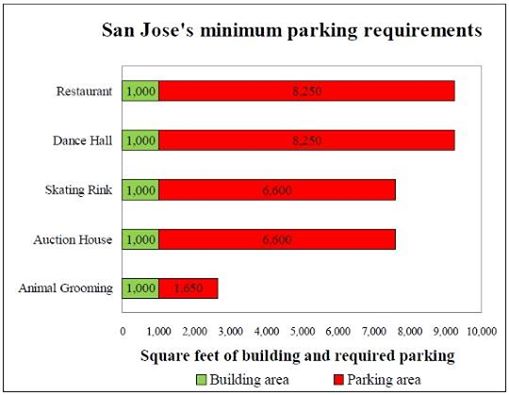
In the United States, the number of spots required for off-street parking is largely arbitrary. Consider the following graph showing how San Jose mandates parking space depending on the type of establishment. When pressed to come up with a reason for where they get the numbers, public officials usually claim ignorance or just say it’s how it’s always been.

Parking requirements, San Jose, CA

Some other examples of requirements:

  • 1 space per 10 nuns for a nunnery
  • 1.5 spaces per fuel nozzle for a gas station
  • 1 space per 2,500 gallons of water for a swimming pool
  • 1 space per tennis player for a tennis court
  • 3 spaces per beautician for beauty shop

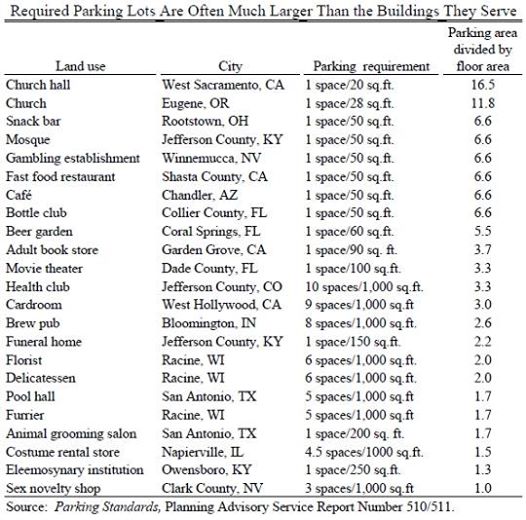
It should be noted that these numbers are created from little data-driven research on efficient land use. One study surveyed 49 cities in the San Francisco Bay Area and found parking required for hospitals ranged between 29 and 1,682 spaces. The differences were uncorrelated to the corresponding cities’ population levels or densities. Why should we allocate land like this when we’d never allocate any other resource with such arbitrary mandates?

Parking requirements compared to building requirements

The Cost of Cheap Parking

Measuring the costs of this distortion can be hard to wrap one’s head around. The only obvious price in the case of free/cheap parking is the price of the parking spot to the driver. Because of this, the costs to sub-optimally priced parking are hidden and diffused across the entire population. Mark Delucchi at University of California – Davis estimates drivers pay between 1-4% of the actual costs of off-street parking. He estimates the annual capital and operating costs of off-street parking in the US to be between $79B and $226B in 2002. Remember that the cost of parking is not only the land used but also the maintenance for the spaces. As a comparison, the US spent $231 billion on medicare the same year. Because drivers pay so little of this, it is essentially a pure subsidy. A gas tax between $1.27 and $3.74 per gallon in 1991 dollars would have to be enacted to offset the subsidy for off-street parking.

But how do the costs of this subsidy manifest themselves? One evident symptom is the sprawl it creates. Any land used for parking is land that cannot be used for residential or business purposes. So if a city block could fit 5 shops in a world with no parking, but a city requires half the block to effectively be used for parking spaces, two blocks are now needed to fit those same 5 shops. Multiply this effect over every different kind of establishment and you can picture how much it spreads everything out.

When one considers the cost of driving a car to a destination versus other forms of transport, many costs add up to create the total cost – fuel, automobile insurance, the car purchase itself, parking etc. By reducing a drivers’ cost of vehicle travel, we are distorting an individual’s travel choices towards cars over other forms of transportation. We are ok to drive more because it’s cheaper than the actual cost of the journey. Off-street parking requirements have existed since the middle of the twentieth century so our habits have adopted accordingly. This sprawl has a spiraling effect and the car dependence is a self-fulfilling prophecy – parking requirements increase mobility by car, but the sprawl decreases mobility by bike, foot, or public transit.

Off-street parking requirements also have the unfortunate effect of reducing the amount of affordable housing. Most municipalities require a certain number of parking spaces based on how many residents will be in the building. This number does not change depending on the demographics of the residents. So if your residents are all poor and don’t have enough money to buy cars, you still need to devote part of your property to parking spaces. This means parking spots for people that don’t own cars and less space devoted to actual residences. A lower supply of housing means higher prices.

These requirements also have a second effect of distorting incentives to build affordable housing in the first place. If the city requires you to include x number of spots per resident, wouldn’t you be more inclined to build bigger tenancies that fit fewer tenants so you have to devote less land to parking? Bigger tenancies with fewer tenants means residencies that are more expensive and out of reach to low-income individuals. Oakland had no parking requirements until 1961. Afterwards, housing density went down 30% (sprawl) and construction costs went up 18% (decreased housing affordability).

Businesses also have distorted incentives in how they build. For a new building, a business can decide its use and then fulfill parking requirements accordingly. For an old building, a business needs to use the parking available as a limitation on its possible uses. If the number of spots wouldn’t satisfy the requirements for your nunnery, swimming pool, or beauty parlor, you need to build elsewhere. This means lots of vacant buildings remain unfilled because of the limited flexibility. It also incentivizes demolition and new development rather than using existing buildings.

Perhaps the most apparent cost is one we’re all accustomed to when trying to find a parking spot – “cruising.” Cruising refers to that tedious amount of time you spend circling the block around your destination hoping someone will leave their spot and you can swoop in. Since the cheap cost of curbside parking has created a shortage of spots, it’s only natural to cruise around until you find one that’s available. Some drivers will pay for lot parking, but why would you if a free spot is just around the corner? As George Costanza said, “It’s like going to a prostitute. Why should I pay for something when, if I apply myself, I can get it for free?” Cruising causes congestion that creates pollution and wastes time and energy. Research estimates that around 30% of cars in congested traffic are cars cruising and up to 45% in Brooklyn. If the line is too long at that free ice cream place, you’re gonna keep scoping out nearby places until you find one that’s available.

The Solution

In order to use land most efficiently, it only makes sense to make parking as expensive as it actually costs. This means having parking be priced according to forces relating to its supply and demand and not arbitrary regulations. Cheap parking enforces inefficient land use in urban sprawl, causes residential and business rents to increase, decreases the amount of affordable housing, and increasing pollution through cruising and the increased transportation time from increased sprawl. This doesn’t mean getting rid of parking altogether. It just means that the price of a car journey should more closely reflect its true cost.

The “right price” for curbside parking has been defined by economist Donald Shoup at the University of California – San Diego as the lowest price that ensures a 15% vacancy rate for a given area. Technology is available that can change this price based on fluctuating demand. Certain neighborhoods in cities like San Francisco and San Diego have effectively utilized this technology. A 15% vacancy rate means just enough cars can park without having an unnecessary amount of cruising.

Businesses naturally will be afraid this increase in price will scare away customers. But remember that the status quo of underpriced parking scares away customers too. Higher prices could incentivize carpooling, since the higher price of parking can be diffused across a handful of passengers. Businesses can also be convinced to embrace this increased price by having the parking revenue be re-invested in the respective business districts. Old Pasadena, a formerly skeezy neighborhood in LA, embraced right price parking and started using the money for district improvement efforts and eventually became a popular entertainment/shopping district. Austin does something similar, investing in trees and sidewalk upkeep with the revenue it gets near the University of Texas campus. In both instances the businesses, though perhaps initially skeptical, have embraced right price parking.

Water flows in the path of the least resistance, and it could be that parkers go from the spots of right price to residential neighborhoods with cheaper parking. So what’s the best way to counter-act this problem? Resident-only parking permits tend to over-compensate for this problem by creating an artificial scarcity – many of the spots go unused throughout the day as residents go to work or run errands. Instead, Shoup recommends a scheme where residents and guests park for free in their neighborhood but can charge parkers that want to use their designated spot. Remember all those unused parking spots in the housing for low-income individuals? Why not allow them to rent out their spots to people from other neighborhoods? Otherwise, the land goes completely unused. Cities like Boulder, Aspen, and Santa Cruz have successfully enacted schemes like Shoup’s to efficiently allocate residential parking spaces.

The Endgame

It can be hard to imagine paying more for parking in our given city landscapes. Remember that our cities have developed based on distorted incentives that increase sprawl and devote unnecessary land use to parking. Once parking is priced correctly and parking requirements are removed, land previously used for parking can be devoted to more valuable uses. Cities will slowly become denser and the higher price for parking won’t be as unavoidable as one may think.

The status quo of a car-dependent urban lifestyle does have its perks – cars allow one to carry large items, avoid adverse weather than encountered by biking or waiting at a bus stop, and often gets a traveler quickly from one point to another. But the price of a car journey needs to closer reflect the true cost. An ice cream-dependent urban lifestyle also has its perks – but we can spend all that milk, sugar, labor, and land on better resources.


To hear the ideas of this article presented in podcast form, check out episode 10 of Upset Patterns (iTunes | PodBean). This article draws heavily from Donald Shoup’s 2011 book “The High Cost of Free Parking.