Category Archives: Business

Business: articles that involve morality in business, big or small

The euro is doomed

The euro currency is inevitably doomed. The institutional arrangement is not set up to support a stable currency area and the cultural differences across the eurozone make it nearly impossible to move towards a regime that makes the currency integration beneficial. As countries experience more frustration and powerlessness from giving up significant political and economic autonomy, the arrangement will come apart and the currency will no longer exist in the same form as it does today.

Where’s the fiscal transfer mechanism?

Picture Arizona experiencing a bust in its housing market, a hurricane hitting Florida, or the mines going dry in West Virginia. In each case, the Federal government of the United States steps in to cushion the fall of these economies and their people. Banks might get bailed out, FEMA will dish out aid to rebuild destroyed communities, and medicaid will provide healthcare for those without incomes. The cost of such relief is often too hefty for one state to bear on its own. The Federal Government thus acts as an insurance mechanism so that different regions in the US can spread the risk from negative shocks. Political quibbles inevitably follow about the efficacy and bureaucratic process of these programs. But rarely will you hear accusations of Floridians displaced by a hurricane as “moochers” or recently unemployed rust-belters as “lazy.” Those left unaffected by such shocks living in Massachusetts or California see the people in these states as Americans and recognize that such Federal mechanisms are a part of the American system.

The Federal Government’s ability to take from a general fund of taxpayer dollars and redistribute across different states at different times is called a “fiscal transfer mechanism.” It not only serves as an insurance plan in the scenarios above, but can function to consistently redistribute income from richer states to poorer states. People in Connecticut and Maryland pay more into the Federal tax system than they take out, while states like West Virginia and Mississippi are net beneficiaries of the Federal government. Thus, independent of shocks like natural disasters or economic crises, some states get more from the Federal government and some get less. Political arguments over these transfers are constant, as politicians push for pork-barrel spending that disproportionately benefits their state. In equilibrium, however, this system exists.

Compare this to the eurozone, another consortium of polities with a supra-national power presiding over them. What happens if Italian banks fail or Greece overextends its fiscal accounts and is on the brink of default? Citizens of the countries that have sound banks and followed fiscal restraint don’t have the same instinctual support that Americans feel for their countrymen three time zones over. Germans think Greece’s fiscal insolvency is a self-inflicted problem that involves painful lessons to be learned. People in Ireland look at Portugal’s fiscal woes and wonder why the Portuguese can’t tighten their belts like the Irish did. The eurozone, by design in the Maastricht Treaty that brought them all together, forbids bailouts of national governments. In other words, the fiscal transfer mechanism cannot legally exist. As a result, more often than happens to states in the US, countries in the eurozone are forced to absorb the costs of these shocks entirely on their own, and these costs can be insurmountable.

How different currencies would cushion the blow

Yanis and Schauble
Wolfgang Schäuble, Germany’s Federal Minister of Finance, and Yanis Varoufakis, former Minister of Finance of Greece. Source

European countries survived on their own before they were in the eurozone, so what makes this arrangement different? The currency union itself is preventing smoother adjustment. When a country like Peru experiences a shock like a natural disaster, banking crisis, or garden variety recession, the weaker economy naturally weakens its Sol currency. This in turn causes Peruvian exports to become more competitive and the economy is on the road to recovery. Peru’s central bank can lower interest rates, too. This encourages more investment and gets the engines of the economy pumping again. However when Italy reaches high levels of unemployment, its currency doesn’t weaken in step with Italy’s economy. The exchange rate of the euro is tied to the eurozone as a whole, of which Italy is only about 10%, and Italy can’t lower interest rates to ramp up investment. The short-term interest rate is set by the European Central Bank which is set by bureaucrats all across the zone. So an Italian recession is accompanied by a stronger-than-should-be currency and interest rates that are higher than they would like.

Economic integration will help…in theory

Labor mobility is another way an economic area moves towards equilibrium when certain areas are hit harder than others. Here, the legal framework for the eurozone works in its favor. The Schengen Agreement allows for Schengen Zone citizens to work anywhere in the Zone, no matter their passport. This means that if Spain has a high number of unemployed workers, some of them can go over to Austria where the labor market is a little healthier. The shock is absorbed by Austria and things reach a happier equilibrium. When midwestern states in America experienced decline from fewer jobs in manufacturing, people headed to sun belt states like Arizona or Texas that have more opportunities. So why isn’t this happening in the eurozone?

Moving from Ohio to New Mexico is much easier than moving from Spain to Austria. Crucially, English is the dominant language in any American state. The cultures of different areas in America may be distinct, but they’re peanuts compared to the differences of countries in Europe with thousands of years of history that form their identities. What if a Greek with little formal education wants to move to Austria… What are the odds they’ll know German? The stigma against workers from lower-income countries like Poland or Bulgaria often make it difficult to find work in France or Belgium. Xenophobia within the eurozone discourages labor mobility that would other equilibrate labor markets more smoothly.

If labor mobility were perfect in the United States, people in West Virginia would be moving to places like Massachusetts, Texas, Silicon Valley, or North Dakota. Moving is tough. People set up roots, form communities, buy mortgages, and get used to local norms. It’s not as easy as packing up one day and leaving the next. Throw in cultural and linguistic barriers to this and the eurozone labor market is not nearly as integrated as it is in legal terms.

Europe is not the United States

The United States doesn’t have perfect harmony across the country, of course. Historically, national harmony was incredibly difficult. Since the founding of the country, there has been a constant push and pull between states’ rights and giving more power to the Federal government. The campaign towards states’ rights is founded on the idea that states have different beliefs and should be able to operate with a high level of autonomy. Heck, there was even a war fought over a critical disagreement that took the lives of over six hundred thousand Americans. And, in many ways, those two sides still remain divided via other ideologies one hundred fifty years later. Simply put, the United States got to be where it is today after more than two centuries of friction and it wasn’t easy. Even with all that, it benefitted from having tremendously more linguistic homogeneity than Europe has and it didn’t have millennia of regional identity baked in to individual identity. Furthermore, Project Euro has attempted to expedite this tough process of integration and identity in a mere 17 years. Having eurozone citizens suddenly consider themselves “European” before considering themselves “German” or even “Bavarian” isn’t going to happen anytime soon.

The unstable equilibrium
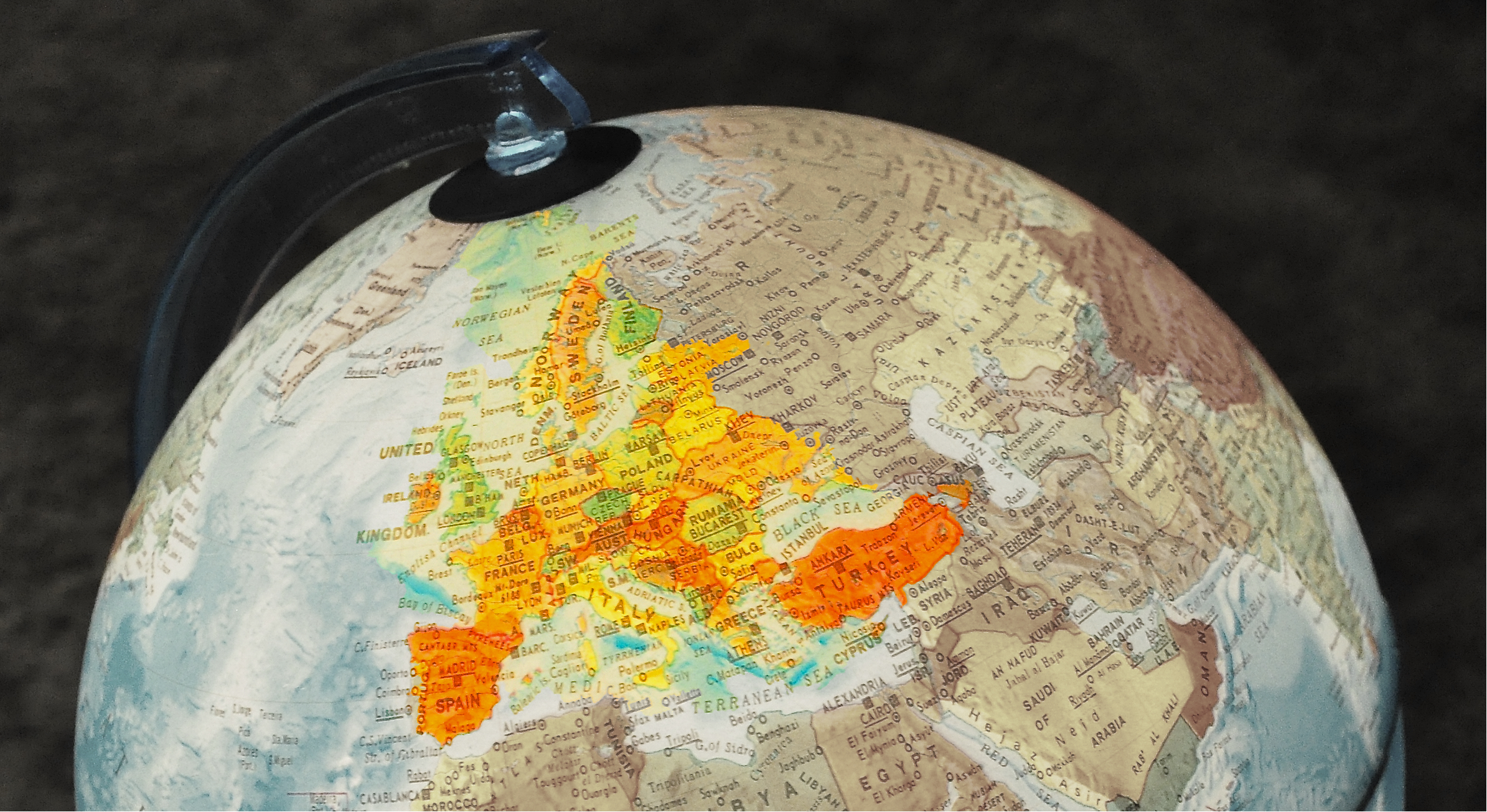
Globe with europe highlighted
Source

The only solution to the eurozone’s problems is More Europe. That means a more-powerful European government that can provide a fiscal transfer mechanism and a move away from national identity and towards a European one. The first part can be done politically, the second is left up to the people. If the eurozone moves in a direction of nationalism and isolation, its problems will persist and only get worse. Right now, the zone is a house of cards ready to collapse into Less Europe unless it can search deep down for the political capital to give it the strength it needs to stay together.

The result of the Brexit referendum in June, while not technically involving the eurozone, reflects the tension of the struggling European identity. Brits felt they were giving too much to the European Project and decided to go down a path that emphasizes national identity more than integration. The unfulfilled promises of a more-integrated Europe were disappointing enough to have Britons call it quits. As Germans and Greeks increasingly resent each other’s norms, convincing either side that the solution to their problems is more integration is near impossible.

The reforms needed to keep the eurozone intact are dramatic and especially difficult to pass in a stagnant economy that’s dealing with millions of refugees knocking at the door. While the eurozone may make the necessary changes, time is running out. The political climate is shifting strongly towards Less Europe, and once the direction gains momentum, it will be difficult to ever turn back.


Don’t Blame Dilma Rousseff for Brazil’s Woes

Brazil’s economy in the last 15 years is a prime example for how we tend to unfairly ascribe massive political events to individual leaders. On the 12th of May 2016, Brazil’s Congress temporarily suspended sitting President Dilma Rousseff while they bring charges against her related to alleged manipulation of the public budget.

While Rousseff may be guilty of fudging treasury accounting, her crimes are minor compared to most others in Brazil’s Federal government: half of said Congress is under investigation for involvement in the so-called “Car Wash” scandal, where politicians traded government contracts for massive bribes. The interim President, Michel Temer, stinks of corruption to the point of being disqualified for re-election in 2018. A leader of the charge against Rousseff, Eduardo Cunha, resigned from his position as House Speaker earlier this week under allegations of corruption.

Opinion polls showed strong public support to remove Rousseff from office. Why? Brazilians are suffering in an economy that has shrunk more than 7% in the last two years. They want a scapegoat. Although any honest appraisal of the political situation in Brazil would show Rousseff relatively innocent compared to her colleagues, the citizens are looking for someone to blame.

On the surface, Rousseff was an inept politician that drove her country into financial turmoil through mismanagement and unwillingness to get spending under control. But in reality, the country’s nosedive is the result of forces outside of her control.

Brazil: 2002-2016

Dilma Rousseff and Luiz Inácio Lula da Silva

Luiz Inacio Lula da Silva, better known as “Lula,” ruled as President of Brazil from 2002 until 2011. Lula left office with sky-high approval ratings and was praised by President Obama as “the most popular politician on earth.” Lula came from incredibly modest roots in the poor northeast of Brazil and successfully led his Workers Party (PT) in efforts to dramatically redistribute wealth in Brazil. A global commodity supercycle timed favorably with Lula’s rise to power: commodity prices tend to be cyclical and they happened to be high during Lula’s reign. When the stuff Brazil was selling to the world—iron ore, oil, soybeans, corn—became a lot more expensive, Brazilians became richer. This also meant Brazil’s government had more money to spend on things like healthcare, education, and pensions. The music eventually stopped and the Brazilian government couldn’t afford to hand out as many goodies. The promises made by the generous social welfare system put into place during the commodity boom remained after Lula left office.

Enter Dilma Rousseff

Dilma took power in 2011 with Lula’s economic boom lingering. A growing Brazil looked poised to join the ranks of other emerging market economies like China and India that were on the verge of competing with the West. Brazil locked in the World Cup in 2014 and the Olympics in 2016. But in the middle of 2014, when commodity prices started to crash, Brazil’s economy stalled and began a downward trajectory it has yet to recover from two years later. Today, Brazil is set to shrink for a second consecutive year, faces nearly double-digit percentage increases in consumer prices, and has public finances on an unsustainable trajectory.

From the perspective of the casual onlooker, the respective legacies of Lula and Rousseff are simple: Lula led Brazil to roaring growth and took millions out of poverty; Rousseff was an inept politician that sparked Brazil’s downward spiral.

But look closer at the causes of Brazil’s economic performance during the two’s rule: Lula held office at a time when commodity prices were soaring. Nearly half of Brazil’s exports are commodities. The world economy was stronger in the 00s than it is now, meaning other countries had more money to buy the stuff Brazil was digging out of the ground. Rousseff survived one term with decent commodity prices but was in power when the price of iron ore and oil fell 67%, corn lost a quarter of its value and soybeans cheapened by nearly half. These underlying conditions had nothing to do with either Rousseff or Lula.

Brazil’s Problem #1: Struggling Public Finances

The most urgent issue facing Brazil is its public finances. Unfortunately, a legacy of yesteryear in Brazil is that around 90% of government spending is ring-fenced from Congressional discretion. It takes constitutional amendments to change the formulae that determine spending on pensions, healthcare, and education. This means that when Brazil’s economy has shrunk by nearly 7% in two years, the government has its hands tied when it comes to any necessary belt-tightening. If you think it’s hard to take away people’s entitlements in good times, what do you think the political popularity of pension reform is when everyone is already 7% poorer?

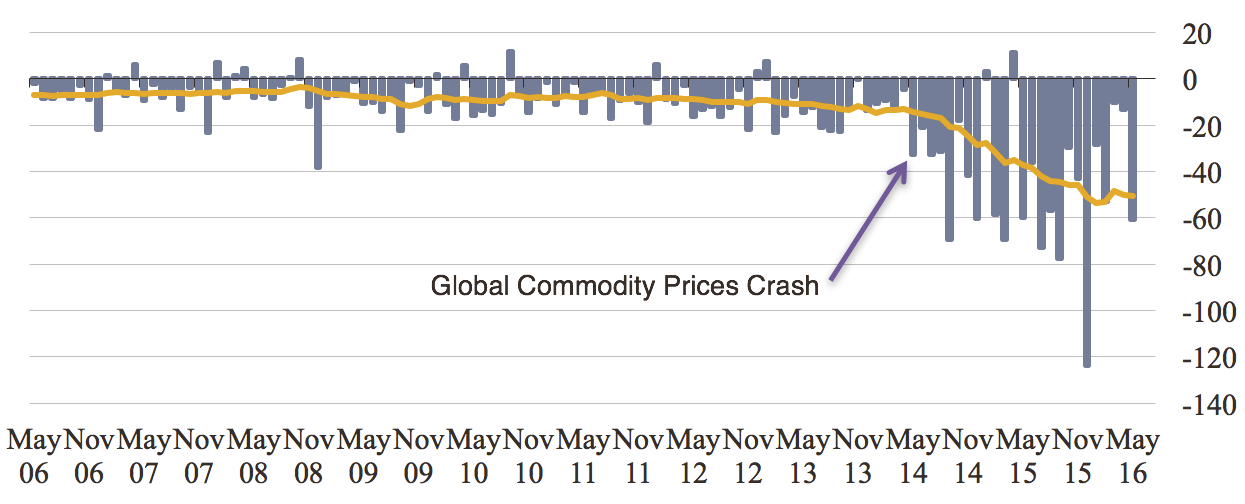
Graph of Brazil's Public Sector Balance
Brazil’s Public Sector Balance, Billions of $R (Yellow line: 12 month moving average)

The annual deficit as a percentage of GDP has gone from 3% to over 10%. As the situation has deteriorated, creditors feel like lending to Brazil’s government is riskier. So interest rates go up and borrowing becomes more expensive… the vicious cycle deepens.

By having direct stakes in commodity-producing companies like Eletrobras and Petrobras, Brazil’s government loses financially when these companies struggle. Not only do those companies’ struggles mean less tax revenue—standard in a recessionary economy—but the losses on the books of those companies translate into losses of the government. In other words, Brazil’s government is forced to subsidize failing companies.

Brazil’s Problem #2: Price and Wage Indexation

The government policies that made Brazil’s adjustment to lower commodity prices as painful as it has been were set in place long before Rousseff took office. A huge chunk of wages and prices in Brazil are indexed to inflation from the previous year, meaning typical remedies to simmer price levels like higher interests rates or lower aggregate demand are virtually ineffective. Sky-high interest rates (14.25% in Brazil whereas higher income countries have had interest rates near or even below zero in the time since the financial crisis) aren’t expected to get consumer prices down to their targeted level for at least another year and a half. The stubborn persistence of inflation in Brazil is around regardless of any strong will or intelligence from the one who resides in Palácio do Planalto.

Palácio do Planalto: official workplace of the President of Brazil

The collapse in commodity prices hit Brazil’s currency that set off the bout of inflation. As demand for its exports tanked, the demand for its currency fell, too. The falling value in the Brazilian real resulted in a 50% depreciation against the American dollar in the last couple years. When the country’s currency can buy less abroad, its imports get more expensive. This set off the spike in inflation seen in the last two years.

Inflation is bad in any economy because it causes “noise” in the price system and discourages long-time planning that is strongly tied to economic growth. But it is exceptionally painful for Brazil because their minimum wage is derived from a formula based on last year’s consumer price index and GDP growth from two years ago. In turn, pensions—which make up a little less than half of Brazil’s public budget—are indexed to the minimum wage. Inflation from last year begets inflation this year in a vicious spiral.

The problems that leave Brazil struggling to recover from its latest bust are derived mostly from policies and events completely out of the control of Dilma Rousseff. Similarly, solutions to speeding up a recovery are not within the power of interim President Michel Temer.

Beyond Brazil

Beyond Brazil, political leaders are given blame or credit for their countries’ performance that far exceeds their true influence. In order to assess the true impact of a leader, one must tease out the vast array of events that happen outside of a leader’s control. A paper from William Easterly and Steven Pennings found the relationship between leadership and economic growth to be very weak, after controlling for variables across time and space. So-called ‘benevolent dictators,’ like Singapore’s Lee Kuan Yew, get credit for their countries’ economic performance, but how much of it really had to do with leadership?

The tendency for observers to attribute events to a single leader or small group comes from the appeal to simplify our enormously complex world. If the world’s ills are the result of billions of people behaving in a decentralized manner without conscious intentions of bad results, changing the system seems frustratingly difficult, if not impossible. But if the world is governed by a few small elites, changing the world’s problems seems within our power. Brazilians are much more likely to be drawn to an explanation/solution of their problems that relies on regime change than one that is frankly out of their control. They don’t have the power to vote commodity prices higher and the institutional changes that are needed are, by design, difficult to implement.

The point is not that policy and politics don’t matter. Brazil’s woes after the commodity price crash two years ago have been exacerbated by policies that institutionalized inflation and made necessary fiscal adjustment nearly impossible. The inefficiencies from corruption certainly don’t help either. Instead, rather than ascribe economic performance to omnipotent individuals, we need to recognize that the world’s complexities mean our problems and solutions do not always come from the top-down.

Aparkalypse Now: The Economics of Parking

Imagine your town decides to mandate that all ice cream is free or very cheap. Soon, lines are out the door for people wanting to get cheap ice cream. Sure, people can get similar desserts, but they’d have to pay full price. In order to take care of these long lines, the town decides to mandate that every store must provide free or very cheap ice cream. This might sound silly but it’s exactly how cities deal with parking. Cities price street parking, or “curb parking,” very cheaply and then deal with the excess demand by requiring businesses and residences to have off-street parking. The costs of this distortion of land use may not be immediately obvious but they are significant financially, environmentally, and with regards to time.

Land: A Limited Resource

The fundamental problem of economics is finding out how to use the scarce resources we have on Earth in the best way possible. In the case of parking, land is a limited resource with many alternative uses. A typical parking space is around 330 square feet, not including aisles in parking garages and parking lots. 330 square feet is no insignificant amount of space, especially in dense cities. With other resources, we can think of prices as a “signal wrapped in an incentive” that coordinate resources in an economy. A free parking spot in New York City is giving away some of the most valuable land on Earth and completely ignoring the price system as a means for allocation. Most cities, due to history and the political inertia of voters being used to free parking, charge too little for curb side parking. When the price of a resource is lower than what the market would otherwise dictate, there is a shortage. If ice cream were close to free, people would want to consume more of it than was available. The land used for parking is no exception. To get rid of this shortage, public policy has been set mandating more off-street parking.

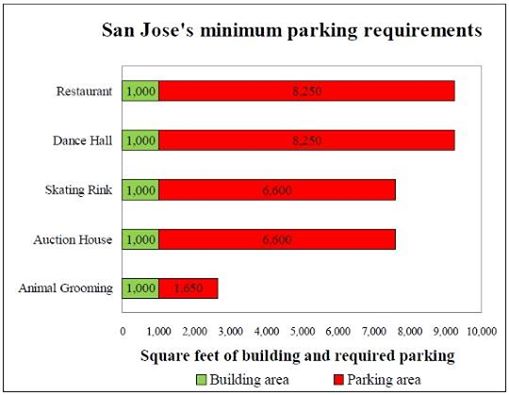
In the United States, the number of spots required for off-street parking is largely arbitrary. Consider the following graph showing how San Jose mandates parking space depending on the type of establishment. When pressed to come up with a reason for where they get the numbers, public officials usually claim ignorance or just say it’s how it’s always been.

Parking requirements, San Jose, CA

Some other examples of requirements:

  • 1 space per 10 nuns for a nunnery
  • 1.5 spaces per fuel nozzle for a gas station
  • 1 space per 2,500 gallons of water for a swimming pool
  • 1 space per tennis player for a tennis court
  • 3 spaces per beautician for beauty shop

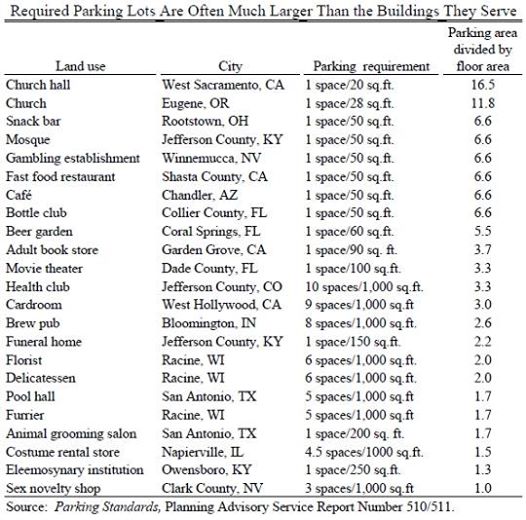
It should be noted that these numbers are created from little data-driven research on efficient land use. One study surveyed 49 cities in the San Francisco Bay Area and found parking required for hospitals ranged between 29 and 1,682 spaces. The differences were uncorrelated to the corresponding cities’ population levels or densities. Why should we allocate land like this when we’d never allocate any other resource with such arbitrary mandates?

Parking requirements compared to building requirements

The Cost of Cheap Parking

Measuring the costs of this distortion can be hard to wrap one’s head around. The only obvious price in the case of free/cheap parking is the price of the parking spot to the driver. Because of this, the costs to sub-optimally priced parking are hidden and diffused across the entire population. Mark Delucchi at University of California – Davis estimates drivers pay between 1-4% of the actual costs of off-street parking. He estimates the annual capital and operating costs of off-street parking in the US to be between $79B and $226B in 2002. Remember that the cost of parking is not only the land used but also the maintenance for the spaces. As a comparison, the US spent $231 billion on medicare the same year. Because drivers pay so little of this, it is essentially a pure subsidy. A gas tax between $1.27 and $3.74 per gallon in 1991 dollars would have to be enacted to offset the subsidy for off-street parking.

But how do the costs of this subsidy manifest themselves? One evident symptom is the sprawl it creates. Any land used for parking is land that cannot be used for residential or business purposes. So if a city block could fit 5 shops in a world with no parking, but a city requires half the block to effectively be used for parking spaces, two blocks are now needed to fit those same 5 shops. Multiply this effect over every different kind of establishment and you can picture how much it spreads everything out.

When one considers the cost of driving a car to a destination versus other forms of transport, many costs add up to create the total cost – fuel, automobile insurance, the car purchase itself, parking etc. By reducing a drivers’ cost of vehicle travel, we are distorting an individual’s travel choices towards cars over other forms of transportation. We are ok to drive more because it’s cheaper than the actual cost of the journey. Off-street parking requirements have existed since the middle of the twentieth century so our habits have adopted accordingly. This sprawl has a spiraling effect and the car dependence is a self-fulfilling prophecy – parking requirements increase mobility by car, but the sprawl decreases mobility by bike, foot, or public transit.

Off-street parking requirements also have the unfortunate effect of reducing the amount of affordable housing. Most municipalities require a certain number of parking spaces based on how many residents will be in the building. This number does not change depending on the demographics of the residents. So if your residents are all poor and don’t have enough money to buy cars, you still need to devote part of your property to parking spaces. This means parking spots for people that don’t own cars and less space devoted to actual residences. A lower supply of housing means higher prices.

These requirements also have a second effect of distorting incentives to build affordable housing in the first place. If the city requires you to include x number of spots per resident, wouldn’t you be more inclined to build bigger tenancies that fit fewer tenants so you have to devote less land to parking? Bigger tenancies with fewer tenants means residencies that are more expensive and out of reach to low-income individuals. Oakland had no parking requirements until 1961. Afterwards, housing density went down 30% (sprawl) and construction costs went up 18% (decreased housing affordability).

Businesses also have distorted incentives in how they build. For a new building, a business can decide its use and then fulfill parking requirements accordingly. For an old building, a business needs to use the parking available as a limitation on its possible uses. If the number of spots wouldn’t satisfy the requirements for your nunnery, swimming pool, or beauty parlor, you need to build elsewhere. This means lots of vacant buildings remain unfilled because of the limited flexibility. It also incentivizes demolition and new development rather than using existing buildings.

Perhaps the most apparent cost is one we’re all accustomed to when trying to find a parking spot – “cruising.” Cruising refers to that tedious amount of time you spend circling the block around your destination hoping someone will leave their spot and you can swoop in. Since the cheap cost of curbside parking has created a shortage of spots, it’s only natural to cruise around until you find one that’s available. Some drivers will pay for lot parking, but why would you if a free spot is just around the corner? As George Costanza said, “It’s like going to a prostitute. Why should I pay for something when, if I apply myself, I can get it for free?” Cruising causes congestion that creates pollution and wastes time and energy. Research estimates that around 30% of cars in congested traffic are cars cruising and up to 45% in Brooklyn. If the line is too long at that free ice cream place, you’re gonna keep scoping out nearby places until you find one that’s available.

The Solution

In order to use land most efficiently, it only makes sense to make parking as expensive as it actually costs. This means having parking be priced according to forces relating to its supply and demand and not arbitrary regulations. Cheap parking enforces inefficient land use in urban sprawl, causes residential and business rents to increase, decreases the amount of affordable housing, and increasing pollution through cruising and the increased transportation time from increased sprawl. This doesn’t mean getting rid of parking altogether. It just means that the price of a car journey should more closely reflect its true cost.

The “right price” for curbside parking has been defined by economist Donald Shoup at the University of California – San Diego as the lowest price that ensures a 15% vacancy rate for a given area. Technology is available that can change this price based on fluctuating demand. Certain neighborhoods in cities like San Francisco and San Diego have effectively utilized this technology. A 15% vacancy rate means just enough cars can park without having an unnecessary amount of cruising.

Businesses naturally will be afraid this increase in price will scare away customers. But remember that the status quo of underpriced parking scares away customers too. Higher prices could incentivize carpooling, since the higher price of parking can be diffused across a handful of passengers. Businesses can also be convinced to embrace this increased price by having the parking revenue be re-invested in the respective business districts. Old Pasadena, a formerly skeezy neighborhood in LA, embraced right price parking and started using the money for district improvement efforts and eventually became a popular entertainment/shopping district. Austin does something similar, investing in trees and sidewalk upkeep with the revenue it gets near the University of Texas campus. In both instances the businesses, though perhaps initially skeptical, have embraced right price parking.

Water flows in the path of the least resistance, and it could be that parkers go from the spots of right price to residential neighborhoods with cheaper parking. So what’s the best way to counter-act this problem? Resident-only parking permits tend to over-compensate for this problem by creating an artificial scarcity – many of the spots go unused throughout the day as residents go to work or run errands. Instead, Shoup recommends a scheme where residents and guests park for free in their neighborhood but can charge parkers that want to use their designated spot. Remember all those unused parking spots in the housing for low-income individuals? Why not allow them to rent out their spots to people from other neighborhoods? Otherwise, the land goes completely unused. Cities like Boulder, Aspen, and Santa Cruz have successfully enacted schemes like Shoup’s to efficiently allocate residential parking spaces.

The Endgame

It can be hard to imagine paying more for parking in our given city landscapes. Remember that our cities have developed based on distorted incentives that increase sprawl and devote unnecessary land use to parking. Once parking is priced correctly and parking requirements are removed, land previously used for parking can be devoted to more valuable uses. Cities will slowly become denser and the higher price for parking won’t be as unavoidable as one may think.

The status quo of a car-dependent urban lifestyle does have its perks – cars allow one to carry large items, avoid adverse weather than encountered by biking or waiting at a bus stop, and often gets a traveler quickly from one point to another. But the price of a car journey needs to closer reflect the true cost. An ice cream-dependent urban lifestyle also has its perks – but we can spend all that milk, sugar, labor, and land on better resources.


To hear the ideas of this article presented in podcast form, check out episode 10 of Upset Patterns (iTunes | PodBean). This article draws heavily from Donald Shoup’s 2011 book “The High Cost of Free Parking.